Friday, May 13, 2011

Game of Thrones Ep 4: Cripples, Bastards, and Broken Things

Well, thanks to stupid *&$@ing Blogger, they went down for maintenance yesterday and when the blogs came back up, the most recent posts were missing. Frak. So here is my Game of Thrones post again (unfortunately, Chris's mirror post is also gone) and I'm going to cut and paste the comments back in, although it'll look like they're all from me. Luckily I have copies of each one in my email (if I miss any of you, I'm terribly sorry). ARGH. I should have switched to WordPress.


Welcome to Week 4 of the Game of Thrones blog, where my partner Christopher Lockett and I talk about this week’s episode; me as a n00b who’s never read what I’m convinced must be George RR Martin’s masterpiece series of books, and Chris as the guy who’s read them and knows what’s coming (he will simultaneously post this over on his blog here). This week we’re going to try something a little different, with us discussing the episode back and forth rather than separately. Let’s see if we can make it work.

Nikki: And Game of Thrones knocks another one out of the park with this week’s stellar instalment. Chris and I were both talking last week about how much information was jammed into episode 3, and how that episode was a bit of a welcome lull in the action to stop, go back, and fill in a lot of backstory on several characters. This week we take that information we now know... and add more. There were many new scenes of exposition, but these seemed more anecdotal and less integral to the history of the series. They were told with thrilling suspense, and I couldn’t help but wonder time after time if these scenes were taken right from the book or if they were bringing various histories together to convey it to us very quickly. A real standout is Viserys telling the slave girl about the dragon skulls that used to decorate his father’s throne room, with Viserys being understood to be the last of the dragons (I find that hard to believe). This story was fascinating. Do the books go back in time and fill in more details about the dragons themselves? Or was it summed up in this succinct scene in the books as well?

Chris: I’m still somewhat speechless over this last episode. I think you’re spot on, Nikki, in noting that the exposition is more anecdotal—but that imparted more background information and context almost by dint of being anecdotal, which is kind of impressive when you think about it. And while the series is far more compressed in its exposition, this is more or less the way it falls out in the novels. There are no flashbacks or historical sequences per se—there are a few instances of characters reminiscing or dreaming past incidents—but for the most part, we get a sense of history in the books precisely by characters talking, sharing stories, and so on. Now, that may change in A Dance With Dragons, the new novel coming out in July; GRRM has said that the timeline will blow our minds, which has been variously interpreted as meaning that he does go back in time to give us backstory, or possibly just that the various overlapping narratives will make it hard to figure out chronological sequence. Given the nature of the books so far, I’m assuming it’s column B, but we’ll see.

I think my favourite backstory moment was Tyrion’s nasty taunting of Theon Greyjoy. I’ve been wondering when we were going to get to his story: he’s been present at Winterfell this whole time, obviously not one of the Stark children but not exactly a servant, and I was getting a little concerned … thinking that the longer they went without fleshing him out, the more awkward it was going to be when they did. And I needn’t have worried: Tyrion’s lovely little condescending disquisition on Theon’s father’s failed rebellion was beautifully succinct. But then, I know the history there—did you find any of the moments like this confusing or opaque?

Nikki: Great scene choice, because yes, the first time I watched this scene I looked at my husband with a completely puzzled look and said, “Wait... who is he supposed to be?” There had been hints along the way that he wasn’t one of Stark’s sons – I remember when they were passing out the direwolf pups he said something about not being able to have one – but it still wasn’t clear exactly who he was. Even with the explanation it was still a little foggy, but many of the backstories of the secondary characters are pretty difficult to follow. It doesn’t bother or worry me – I figure in time, it’ll all be clearer once we not only know these people better, but their stories begin to converge and/or take on lives of their own.

My favourite anecdote in the episode was Littlefinger’s story of the The Mountain and The Hound. You mentioned last week that you thought the Hound’s face was disappointing, that it should have been far more horrifying than it actually is on the show. Did you continue to think that this week? There’s something very interesting in his face, I think... it’s horrific from one side, normal from the other, and I don’t know if that’s a comment on his personality but it certainly seems so (he comes across as gruff, but not vicious, and I wonder if you actually tried to speak to him on a normal level if he’d respond). I also found some sadness in the way his hair falls on the right side of his head, as if he’s trying to cover up something that simply can’t be covered up. He doesn’t get one of those masks Jack Huston’s character, Richard Harrow, wears in Boardwalk Empire.

This episode had a lot of one-on-one moments, where you simply had two characters in a scene (many scenes have been like that, actually). I LOVED when Daenerys whacked Viserys in the head and threatened him. It’s a moment that turns her story around completely... it began as something almost misogynist and became a very feminist take on this powerful character. Are GRRM’s books as openly feminist as this or have they twisted the story for TV?

Chris: One of the most amazing elements of GRRM’s books is their strong women. The fantasy genre can be pretty regressive sometimes in terms of its representations of women—though to be fair, it has gotten better. But GRRM’s women are remarkable and, if anything, they’re more muted in the series. Though that might just be the natural advantage fiction has over film to provide nuance. And for the record, the scene between Daenerys and Viserys is pretty spot-on to the way it unfolds in the novel.

David Simon once compared the way The Wire unfolded to a Russian novel—where you struggle through the first hundred pages or so, totally at sea in the multiple narratives and huge cast of characters, but after a certain point you stop doing the heavy lifting and instead the story carries you. I always thought that was an excellent description not just of how The Wire worked, but also HBO series generally … and GoT is no exception. At a certain indeterminate point, you just go with it. That may be a disadvantage to all us GRRM geeks … we miss that moment when the struggling to keep up stops and we’re just swept up in the narrative(s).

I find it interesting that they rejigged the story of The Mountain and The Hound to have Littlefinger telling Sansa. In the book, it’s the Hound himself who tells her, and it’s a moment of rare, raw sympathy for that character. What I do love about having the story come from Littlefinger is that you simply don’t know whether to believe him or not. Is this a true story? Or is he telling it to impress Sansa, whom he so creepily compares to her mother? Or is he playing some other inscrutable game?

I agree, the Hound’s scarring looked better in this episode. He still hasn’t been as terrifying as he is in the book, but that might also be a function of how the book unfolds from different characters’ points of view. In the novel, a lot of our impression of the Hound comes by way of Sansa, who in her love of all things unicorny and pretty would be doubly horrified by his disfigurement … and the comparable disfigurement of his character.

What did you think of the bits at the Wall? I think Jon’s confession that he couldn’t bring himself to sleep with Rosie because he was afraid of fathering a bastard was quite well done. Alliser Thorne’s subsequent rant about the dangers they would face was perhaps my least favourite part of the episode …

Nikki: I thought the same thing about Littlefinger’s story... I can’t figure that guy out at all. Was he just trying to spook Sansa when he told her she could never tell the Hound that she knew his story, or was he telling the truth? Similarly I liked the scene when he was pointing out all the spies in the garden to Ned, and I felt like I really couldn’t trust him. But the very point he’s trying to make is that you can trust no one (notice he tells Ned to send his most trusted man to the blacksmith shop, and Ned does send his most trusted man: himself).

In this episode I actually found the Wall moments to be less intriguing than the others; I was looking forward to getting back to King’s Landing every time they were at the Wall, although I thought Thorne’s talk about what the last winter was like was rather harrowing.

One moment that particularly intrigued me in the episode was Ned talking to Arya, who was standing on one foot and trying to become like a cat. He tells her in no uncertain terms that she will marry someone important and will give birth to boys who will be knights and will reign the lands. He tells her this thinking this is what she wants to hear, but it’s actually the sort of thing Sansa aspires to, not Arya, and she says as much, saying that’s not the sort of life she plans to lead as she goes back to the top of the stairs to continue standing on one foot. What was so wonderful about this scene is that it stands in complete contrast to last week’s scene with Joffrey and Cersei. She tells him that he will be king and will rule the land in any way he wants. He listens to the hype and believes every word of it, puffing himself up with such airs that you just want to stick a pin in him and watch him deflate. Like Ned, she states his future as if it’s already set in stone, but while Joffrey goes along with whatever Mommy tells him, Arya has a mind of her own, and she refuses to be pigeonholed into whatever her dad tells her she will be. And unlike Cersei, Ned actually seems to take pleasure in his daughter’s defiance.

But what about that last scene? Not only do we get a lot of Catelyn’s backstory, but it’s just pulled off with such aplomb I was thrilled by it. I really adore Tyrion (he shone throughout the episode) but Dinklage is superb in this scene, the way he looks to the side and is genuinely shocked and pleasantly surprised to see her sitting there, and then listens to her calling out to each of the clans without ever catching on to what she’s doing, and when he finally realizes what’s happening, his face is priceless. I’ve thought he was brilliant up to now, but in this scene he really rises up and brings it to a whole new level of really subtle facial acting. You seem to know a lot more about Catelyn than we know in the series so far; is her backstory something that comes later in the books or at this point in the action do you already know a lot about her?

Chris: Can I just say I cannot wait to see how they do the bit with Arya chasing cats? It’s wonderfully described in the book; the actress playing Arya has been so perfect, this can only bring the awesome.

The scene between Ned and Arya goes back to our comments above about the strength of GRRM’s female characters. Arya’s matter-of-fact rejection of the life Ned predicts for her is both a beautiful counterpoint to Joffrey’s arrogant acceptance of his mother’s dreams of power, and—taken in the abstract—a poignant, brief commentary on the constraints on women’s roles. Ned may indulge her tomboyish tendencies, but that doesn’t change the fact that a nobly born woman makes very few choices in her life. Of course, and this shouldn’t come as a galloping great shock to anyone who’s been paying attention, the fates have something entirely different in store for Arya than the life Ned outlines; and paralleling Arya’s resistance to those expectations is the slow realization on Sansa’s part that the life she dreams of is not golden and beautiful. The brutal death of Ser Hugh in the tourney right in front of her rips through the pomp and pageantry of mock battle to suggest the terror of true battle, and to show that not all knights are chivalrous ... all of which unfolds within the slowly dawning realization that princes can be sociopaths.

I think this last realization found expression with Septa Mordane in the Throne Room, when she interrupts her to ask of this was where the Mad King killed her grandfather and uncle. Several times in the books she is told, but several characters, that “life is not a song.” Here we see her starting to grasp that.

And yes—that final scene was superb, and another sequence that perfectly mirrors the book. Both Michelle Fairley and Dinklage were spot-on, and Dinklage’s expression as the swords are drawn on him is priceless. At this point in the book, you do know a fair bit about Catelyn—she’s pretty fully fleshed out. There is more to learn about her as the books progress, and more details and nuances emerge, but we have the broad strokes by this point. You learn a lot more in the book about her background as the eldest daughter of the Tully family, whose seat of power (which she mentions in passing in the scene) is the fortress of Riverrun—a nice little Joycean shout-out.

Tuesday, May 10, 2011

Buffy Rewatch Week 19

3.19 Choices
3.20 The Prom


On the wall above my desk, I have taped three sheets of paper: it’s the complete schedule of this year’s Buffy Rewatch, complete with the names of the contributors on each week (I’ve updated them a couple of times as new people are coming on board for later episodes). I’m happy to say that as of this week, I’m onto page 2.

I don’t have much to say this week, despite “The Prom” being in my top 10 favourite Buffy episodes. Partly because my husband’s been away on a trip for the past week and a half and I’ve been swamped with work and kids and doing stuff on my own (all you single moms out there will always be my heroes), and partly because this week’s guest host has covered just about everything there is to cover on these two episodes (yay!)

I just wanted to mention something coming up in a couple of weeks, though… Angel. Tune in to this blog later this week for a post on the spinoff and how it will be incorporated into the Rewatch. I thought both of these episodes were definitely precursors to the other show, both with creating the pathway that Angel will take to walk away, and also creating other situations that will lead two other characters to follow him to his world in L.A. I’m sure most of you know who, but for those remaining very spoiler-free and who intend to watch Angel, I’ll just say the seeds for that series are in these ones. I love both of these episodes for the way they lead from Earshot (dammit, I should have moved Earshot to be the opening of this week rather than part of last week), which establishes that high school can be horrific, and take it to a new level. These kids are about to graduate into a world that can be hostile and vicious… and that has nothing to do with the vampires lurking about. The choices they’re about to make will inform everything they do. I can’t wait until next week’s eps.

So until then, please allow me to introduce Kristen Romanelli! I met her for the first time at Slayage 4 last June, where she was with her boyfriend David Kociemba, whom I’d met at the previous Slayage. And now I’d like you all to join me in a chorus of “Aww….” when I say that she went to Slayage 4 as his girlfriend, and left as his fiancĂ©e. Kristen has no academic affiliation, but she's a first generation Buffy viewer who works as an interactive producer in Boston. She's can be found (occasionally) blogging on the Watcher Junior blog and (frequently) participating in Monday night #whedony chats on Twitter as @watcherjunior. It took every fiber of her being to not write 1,500 words on Alexis Denisof's eyes.


I have no academic street cred, but I did watch Buffy when it started broadcasting in my sophomore year of high school. I was sixteen, the characters were sixteen, and Sarah Michelle Gellar was 20. I identified with the Scooby Gang, even though I fought against the forces of acne on a weekly basis while they fought against the forces of evil on a weekly basis. Throughout the first three seasons, I felt like I was growing with them in high school. So when the Scoobies were facing the reality of their futures in Choices and The Prom, I was similarly in a state of, “Oh, crap. Now what?” These two episodes aired on May 4 and May 11, 1999; I could taste the end of senior year and the beginning of... well, whatever. I wouldn’t have to worry about that yet, right? Despite the presence of a Hellmouth and the supernatural, the emotions and fears shown in the teenage characters were very real to me and they appropriately reflected what I saw in myself and my friends at this time in our lives.

I view Choices and The Prom as companion episodes because they both explore the question of “What next?” Choices begins by discussing college and post-high school life and The Prom continues this examination using this “end of high school rite of passage thingy” as its framework. Prom is important. If I’ve learned anything from 80s teen flicks, it’s that you must have the perfect dress and the perfect date. Your prom will be in your gym, your punch will be spiked, someone will try to ruin the whole night for everybody, and there’s a prom king and queen. (None of these things were true of my senior prom… aside from the perfect dress and perfect date (my best friend).) In Sunnydale, the prom symbolizes a respite from the inevitability of graduation. Of course, here graduation is not only the end of high school and the beginning of an uncertain future, but possibly the end. They need this dance. But before we get there…

In Choices, the Scoobies begin to get a glimpse of their potential future as college acceptance letters start tumbling into their mailboxes. Willow, as expected by both characters and viewers, has been accepted everywhere that’s anywhere. Xander, also as expected, is playing it cool (Kerouac cool) about the possibility of being left behind both academically and geographically by his closest friends. The real interesting bits come with Buffy and Cordelia. We learned in Lover’s Walk that both girls are very sharp and scored quite high on the SATs (both certainly higher than I scored!), but neither had shown much serious interest in academic pursuits. Nonetheless, Buffy has been accepted to Northwestern. Northwestern! It makes me wonder what other schools (other than UC Sunnydale) she applied to (and for what programs). What does a Slayer’s application essay look like? Buffy is now facing a decision to leave behind her slayage for whatever studies must have interested her at Northwestern.

We know that Cordelia is smart and we know that she loves to rub her success in the face of “losers” like Xander. Especially Xander.

Xander: Any clue on what college you might be attending so we can start calculating minimum safe distance?
Cordelia: None of your business. Certainly nowhere near you losers!
Buffy: Okay, you guys, don’t forget to breathe between insults.
Cordelia: I’m sorry Buffy. This conversation is reserved for people who actually have a future.

So while this exchange has the typical Cordy “bite,” it’s missing her sweet, sweet gloating. Someone with score enough to be declared a “brain” should have lots of thick envelopes to flaunt. Something’s wrong, but we’re not quite sure what. The next day, Xander observes Cordy through the window of “April Fools” (which is, we learn, a perfectly named shop). She’s admiring a grey, shiny dress. Impeccable taste! Xander crosses into her territory and to get in a dig. Cordelia, however is prepared with her thick envelopes of guaranteed future:

Cordelia: And once again, the gold medal in the Being Wrong event goes to Xander "I’m as stupid as I look" Harris. Read ‘em and weep, creep. USC, Colorado State, Duke, and Columbia.
Xander: Wow! These are great colleges. I’m guessing they must have seen a different side of your father’s money.
Cordelia: Go away.

Since when does Queen C retaliate with “Go away”? Especially on her retail therapy turf. To Xander. Yeah, something is definitely up. At the end of Choices, we return to Cordelia in “April Fools” and she’s standing in front of a mirror, admiring the same grey dress we saw earlier. Now, the Cordy we know and love would have slapped down some plastic and bought that dress when we first saw her with it. We learn that Cordy isn’t shopping — she’s a salesgirl. She’s a salesgirl? Our Cordy has gone from retail therapy to retail hell!

It isn’t until right before prom that anyone learns the truth. Xander walks by April Fools again and sees Cordelia gazing at the beautiful grey dress again. He can’t resist going into the store to zing her, but a salesgirl spills the beans about Cordy being an employee, not a shopper. Without anything else to hide behind, Cordy breaks down and confesses to Xander that she’s no longer Sunnydale’s resident rich bitch because her daddy made a “little mistake” on his taxes (for the last twelve years). “Yeah, neato. Now you can run along and tell all of your friends how Cordy finally got hers. How she has to work part time just to get a lousy prom dress on layaway. And how she has to wear a name tag. Oh, I’m a name tag person. Don’t leave that out. The story just wouldn’t have the same punch.” Queen C has fallen and she’s bare in front of Xander, the person that she’s tried to alienate the most.

Her fall into humble doesn’t go unrewarded, however. In her very own Cinderella story, Cordelia discovers, mere hours before prom, that someone has paid the balance of her dress. So when she arrives, she arrives, and she is every inch Queen C. Xander dipped into his “road trip fund” for Cordelia. Although she takes the arm of the “way 007” yet hopelessly dorky Wesley Wyndam-Pryce, she thanks Xander, sincerely, and they silently reconcile. He’s saved her image and he keeps the secret that the future Cordelia, and everyone else, thought she had, is no longer a possibility.

Early in Choices, Buffy ponders the future of her relationship while patrolling with Angel:

Buffy: You never take me any place new.
Angel: What about that fire demon nest in the cave by the beach? I felt that was a nice change of pace.
Buffy: So this is our future? This is how we’re going to spend our nights when I’m fifty and you’re ... the same age you are now.
Angel: Let’s just get you to fifty.
Buffy: Liking that plan.

The ensuing fight quickly distracts both Buffy and Angel from this very real matter that they will have to face at some point. But the couple that slays together stays together, right?

But it seems like everyone around them knows that this is a doomed romance. Even Mayor Wilkins tosses in his observation during one of their “clandestine meetings by dark of night”: “I mean, come on. What kind of a life can you offer her? I don’t see a lot of Sunday picnics in the offing. I see skulking in the shadows, hiding from the sun. She’s a blossoming young girl and you want to keep her from the life she should have until it has passed her by. My God! I think that’s a little selfish. Is that what you came back from Hell for? Is that your greater purpose?”

Damnit, big, stupid, evil guy! And the look on Angel’s face tells us everything. He knows, just as we know, that Wilkins is right. In The Prom Joyce also makes her concerns known by visiting Angel at the mansion. Before Angel answers the door, we see him pick up a notebook with “Buffy + Angel 4 ever!” written in a very girlish hand on its cover (“Sometimes even I forget that she’s still just a girl.”). Oh, dear. I totally had notebook covers (and margins) like that. Joyce tells Angel that he knows what he has end his relationship with Buffy. “…When it comes to you, Angel, she’s just like any other young woman in love. You’re all she can see of tomorrow. But I think we both know that there are some hard choices ahead. If she can’t make them, you’re gonna have to. I know you care about her. I just hope you care enough.”

Joyce, the mother figure of “the good guys,” has perfectly mirrored the words of Mayor Wilkins, the father figure of “the bad guys.” And once again, Angel knows that it’s the truth. He’s pushed over the edge by a nightmare of marrying Buffy (who is wearing an amazing gown), but then witnessing her immolated before his eyes. His love destroys her; he must end it.

Angel takes Mayor Wilkins’ and Joyce’s words to heart, and his breakup with Buffy falls firmly into the “you deserve better” genre. “You deserve more. You deserve something outside of demons and darkness. You should be with someone who can take you into the light. Someone who can make love to you.”

After pleading and fighting, all Buffy has left is, “Is this really happening?”

Her sorrow spills over into her scene with Willow where she sobs, “I can’t breathe, Will. I feel like I can’t breathe.”

The loss of one’s first love feels like this. It may look melodramatic and over the top, viewing it again with thirty year old eyes, but when I was eighteen, this was exactly what being blindsided with a breakup before prom felt like.

Buffy remains in her post-breakup haze until her friends start talking about maybe canceling prom after watching video surveillance footage of Tucker Wells (spoiler: Andrew’s Brother) and his formalwear-hungry hellhounds. Buffy snaps out it and suddenly has a mission. A non-Ascension mission! Buffy must save prom. “You guys are going to have a prom. The kind of prom that everyone should have. I’m going to give you all a nice, fun, normal evening if I have to kill every single person on the face of the earth to do it.” (Spoiler: This reminds me of Buffy’s Season 4 manic need for a perfect, normal Thanksgiving, which itself reminds me of Joyce’s desire for a perfect Christmas (complete with roaring fire during a heatwave) in Amends.)

Buffy takes charge and sends everyone else, even Giles, off to the dance; hunting evil is her coping mechanism. Even ice cream is secondary — “The great thing about being a Slayer? Kicking ass is comfort food.”

It turns out that Tucker is having a little inner turmoil of his own. He asked a girl out to prom and she deadpanned, “No,” in response. Clearly, everyone deserves to suffer. So he does what every disappointed lad would do: He summons a few hellhounds and brainwashes them with Prom Night, Pump Up the Volume, Prom Night IV, Pretty in Pink, The Club, and Carrie. I’m not sure if I should be sad or glad to say that I’ve only seen three of those. Tucker’s redundancy hellhounds are already on their way to the prom, and Buffy is able to catch up to them and kill one of them, but they others ditch pursuing her in favor of finding munchies in the general direction of “Celebration” by Kool & the Gang (a song that will haunt me for the rest of my days as the Fairfield University Class of 2003 Orientation Week & Senior Week theme song). “Oh, come on! That song sucks.” I’m with you, B.

Buffy is able to chase down and kill the hellhounds before they do any damage to the “perfect night” she wanted for her friends. Mission accomplished! She pulls her pink prom gown, the one that she was sure would drive Angel crazy, out of her bag and she’s ready to join civilization where only a select few know what she’s done tonight and countless other nights. …Right?

Class superlatives are awarded at the Sunnydale prom. (“Most Musical” here!) “Class Clown” is awarded to Jack Mayhew, much to Xander’s chagrin. “Anybody can be a prop class clown.” He’s even wearing a balloon animal hat, which harkens back to Season 1’s Nightmares: “You are a lousy clown! Your balloon animals are pathetic! Everyone can make a giraffe!” Buffy seems bored with this whole ritual and partakes in the (weirdly bloody looking, and also reminiscent of the Master’s blood tap in The Wish) punch.

And then Jonathan takes the stage and asks, “Is Buffy Summers here tonight?” This was a weird moment in broadcast. Prior to this episode, Jonathan had just been the weird short kid who got to kiss the Inca Mummy Girl and be “You, by the dip” guy. You see, Earshot hadn’t aired with the rest of the season, in response to the panic the followed the Columbine tragedy. The emotional impact we feel is augmented when watching the episodes in the proper order; we know that Buffy has directly affected Jonathan and saved his life. This moment is special for both of them. It’s also a moment when the class as a whole publicly acknowledges that Sunnydale is not a normal town.

“Most of the people here have been saved by you, or helped by you at one time or another. We’re proud to say that the Class of ‘99 has the lowest mortality rate of any graduating class in Sunnydale history. And we know at least part of that is because of you. So the senior class, offers its thanks, and gives you, uh, this."

Jonathan presents Buffy with a sparkling, cute umbrella with an attached sign that says, “Buffy Summers, Class Protector.”

This is who Buffy is and this is her destiny. She protects the helpless. Whether or not she goes to college, being the Slayer and a protector is inherent to her nature and we know that it’s what she’ll do for the rest of her life. The entire student body recognizes Buffy shows its gratitude for what she does for them. It’s a moment that causes Giles to observe, “I had no idea that children en masse could be gracious.”

As Buffy responds, “Every now and then, people surprise you,” Giles sees what Buffy, and we, cannot: Angel has come to the dance, handsomely dressed in a tuxedo. And when Buffy turns to see him, she doesn’t shatter as she did when he told her that they couldn’t be together anymore. She possibly surprises herself by straightening her back, walking towards him, and greeting him.

Buffy: I never thought you’d come.
Angel: It’s a big night. I didn’t want to miss it. It’s just tonight. It doesn’t mean that I ...
Buffy: I know. I mean, I understand.
Angel: Dance with me?

And as they dance, The Sundays prophetically sing to us…

…Let’s do some living after love dies
Wild horses couldn’t drag me away
Wild, wild horses, we’ll ride them some day


(Spoiler: This song is up there with “Mandy” for Buffy-Angel appropriateness. Go on. Google the lyrics. You know you want to.)

Buffy Rewatch Week 19: Spoiler Forum

And here's the place where you can talk about this week's episodes without worrying about spoiling anyone. There are a few spoilers in the essay above (just highlight any white gaps you see and you'll see them come up). But as I mentioned, I see these two eps as the way out for Angel, Cordy, and Wesley, although Wesley is less obvious. I still can't believe this bumbling guy will become my favourite character. But he will.

Sunday, May 08, 2011

Proud to Be a Mom

When you become a mom there are many, many things you learn very quickly:

• Breastfeeding is what poor people do, and you were given formula when you were a kid and you turned out JUST FINE so stop trying to breastfeed that child because, frankly, it’s embarrassing and not what’s best for it anyway.
• Breastfeeding is the only way to go, and anyone who puts formula in a child’s mouth might as well follow it up with 50 lashes with a cat o’ nine tails because a mother’s milk is the only thing a child should have. I don’t care if your nipples are bleeding, you do NOT give that child formula.
• Everyone has an opinion about what you should be doing, and what you’re doing is probably completely wrong in most people’s opinions.
• People who don’t have children will give you even more advice than people who do (and it usually involves sermons about why spanking to shut that kid up isn’t such a bad thing, and how if they had kids, theirs would NEVER act like that).
• For all the times before you had kids where you also said your kid would never, ever be that one in the grocery store lineup having a freak attack because they can’t have a chocolate bar, you were delusional.
• You really can function on three hours of sleep. Barely, but it’s possible.
• The streets outside are really, really quiet at 3 a.m. when you’re dozing off in a chair while trying to rock a non-sleeping infant to sleep.
• You may think that having a car swerve in front of you without signalling a lane change might cause you to curse and swear more than you ever have before, but nothing brings out the F-word like a child crying moments after you thought they were asleep and you just sat down on the couch to watch TV for the only 15 minutes you had free in the entire day.
• New babies have the most incredible smell, it’s true. That’s really not a myth, and you could get high just sniffing the tops of their heads.
• All the times in philosophy class where the professor pondered the quandary, “do we ever really act in an altruistic fashion? Isn’t every single act we commit just something to make ourselves feel better?” were a load of bunk. Because you quickly realize there is no one on this earth you care about more than that child... not even yourself. (Actually, take a look in the mirror... especially not yourself.)
• Nothing you’ve ever done in your life to this point was this difficult. All those university seminars, or piano recitals, or public speaking engagements, or complex work assignments... child’s play compared to the mindfrak that parenting can be.
• Nothing you’ve ever done in your life to this point was this rewarding. All those professors telling you how brilliant you are, or applause at the piano recitals or speaking engagements, or job well done honours you get from your boss... meaningless compared to being hugged by your child or having them tell you how much they love you.
• The cats that you always said were just like children... are not like children.
• Those cats are pretty awesome for having put up with the children, even if they occasionally stuck out a random revenge claw.
• You stressed and panicked about too many things before... if it doesn’t involve a trip to the ER with your child, or if your heart didn’t skip a beat because you thought something had happened to him or her, then it’s probably not worth stressing out over. The world doesn’t end because someone missed a deadline.
• The same frugality you might show on buying clothes for yourself doesn’t apply when you find a teeny-tiny dress that is so darn cute you just squeed out loud in the store and don’t care how much it costs.
• Kids grow fast. Don’t spend that much money on the teeny-tiny dress when they’re older than one.
• You will never stop feeling your heart bursting with love and joy when you look at your child... when he or she is sound asleep.
• The same thing that someone else’s kid might have said that you didn’t find that funny is SUPER HILARIOUS when your own kid says it, and you will tell absolutely everyone. Even while you’re completely aware they don’t find it as funny as you do.
• Maybe your own parents weren’t as fallible as you thought, and even though you’ve vowed to be even better to your kid than your parents were to you, you’ll make mistakes and your kid will hold them against you, too.
• The pace of your life, speeding faster and faster because you made it that way, honing the talents to do 26 hours worth of stuff in 24, will not slow down when they arrive, no matter how much you wish it would. Before you know it, they’re talking... and have teeth... and they’re moving... and they’re talking back... and they’re walking... and they’re walking away from you... and they’re independent. And you’ll stand back wondering why you didn’t slow it down, despite knowing that you couldn’t.
• Life doesn’t have a pause button, so take a million pictures and use them as your own stopped moments in time. You’ll need them later.
• You’ll never, ever stop worrying about these little people.
• No matter how old they get, when you look at them you’ll see the face of the baby you first laid eyes on, moments after he or she was born, and you’ll wonder how it’s possible that they’re so big now, when you just had them moments ago.
• Mother’s Day means more to you than your birthday or any other holiday. Because you earned it, baby. And it’s lovely being told once a year that someone else knows that.

Saturday, May 07, 2011

Fringe: The End of Days

“You were right. They don’t remember Peter.”
“How could they? He never existed. He served his purpose.”


Oh.

My God.

Tonight’s season 3 finale of Fringe was the most exhilarating hour of TV I’ve watched since the end of Lost, with the same sort of mind-boggling “what the hell is going on” factor that I’ve missed from that other Abrams show. I was gripped right to the end, watching the time travelling argument play out again (this time with Walter convincing Peter one could go back in time to change it, the opposite of Daniel explaining that one couldn’t do that). And that last minute? Full-on hand-over-mouth gasping aloud, with a loud, NOOOO!!! to follow it. To make matters worse? I was watching it alone. (Hm.... like I watched the Lost finale.)

So... as I suspected in my post last week, Peter has jumped ahead in time to a moment after 2021, in our universe. (I giggled this week while watching that I made that assumption last week based on the minute at the end of that episode, only to be met with a ton of comments saying, “Now wait a minute, Missy... you’re not overthinking this enough!” I was thrilled by the response, and felt like I was back in our old Lost discussions... only for it to turn out that it wasn’t meant to be overthought, and we really were in the near future in our world. It made me a bit sad that you guys weren’t right, actually, because I loved the idea of a third universe.)

Peter is now 47, it’s 15 years in the future in 2026. There were hints right away that we were in our world... Ella is there, Olivia’s niece, where in the alt-universe Rachel is dead and Ella never existed. Astrid isn’t autistic (or whatever she is in that other universe) and Broyles is alive, albeit a senator who is blind in one eye. Last week I pointed to the fact that the WTC didn’t exist as the proof, and as suspected, they’ve erected another monument in its place. Others pointed out that the Fringe team wouldn’t be as out in the open as they seemed in that episode, and I suggested that actually, if we consider that for the past decade the vortices have been opening wider, the Fringe team might have been forced out into the open just as it was in the other universe. It appears that’s exactly the case.

The opening credits were neither blue nor red; instead, they were black and white, as if to signal a bleak future that has no colour left in it. When Peter goes to see Walter for the first time in a long time, we’re meet with a repeat of the pilot episode. A shaggy, institutionalized Walter is led out of a holding cell, but this time, rather than being met with an angry, sullen Peter, he’s met by a son who welcomes him and doesn’t seem to hold any ill-will towards him for what he did. Walter appears to have had a stroke (he can’t move his right side the way he moves the left), and Olivia is also very warm to him.

Ella has grown up to emulate her Aunt Olivia, who is now married to Peter quite happily. It’s not clear how long they’ve been married, but they are still passionately in love. Olivia wants children, but cannot convince herself that theirs is a world worth bringing children into. If the End of Days is coming, there’s no future for anyone.

In the present, Walternate is not the bad guy. He’s a man who’s stern and cold, and who has reacted to what was done to him, but he’s also someone we can sympathize with for what he’s been through, and as I’ve said many times, he draws a line on experimentation that Walter didn’t. But in the future, Walternate has snapped, and truly is the bad guy. He’s lost his entire world, and is now on a revenge mission, with Peter as the main target. The red world is gone, and Walternate is the only survivor. The moment that was clear, I couldn’t help but mourn the loss of Alt-Olivia and her newborn baby.

Highlights:
• Gorecki. I can’t even begin to explain the excited gasp I gave when I heard it. When we see the End of Dayers come into the opera hall to set up their device, what you hear in the background is Henryk Gorecki’s Symphony No. 3. Now, it wasn’t live... it’s clear they were simply playing the most famous recording of it, because there’s no doubt that was Dawn Upshaw singing it. But here’s why it excited me... this has been one of my favourite symphonies for years. And I hadn’t listened to the CD in ages when I spotted it on one of our many CD racks a few days after watching the end of Lost, and I put it on. As the music rose and rose in the first movement, I was literally brought to tears because I had the Lost finale on my mind, and it just seemed to encapsulate the glory and massiveness of the whole thing. So, I decided this symphony would be the soundtrack I would use to write it. I put it aside, and when it came time to write the finale chapter, I was alone for a weekend, I had prepared my notes for that chapter over several weeks while writing the previous chapters, and finally I sat down, and put on Gorecki. I listened to that CD on constant repeat for two full days... and I mean constant repeat, from 7am until 11pm for two days. I must have listened to it 40 times. The music swelled as I typed furiously about the history between Jack and Locke. It was quiet as I wrote about the impact that show had on popular culture. Dawn Upshaw’s voice rose majestically as I talked about the church scene. Probably due to a combination of this incredible music, my love for the show, and the sudden realization that hit me as I was working on the Jack/Locke section that this might be the last time I really get to write about those two, I cried for much of it. Tears rolled down my cheeks, hour after hour. I typed 15,000 words on one day, and another 10,000 the next. It’s the most I’ve ever done in a single day, or weekend, but it was because I knew exactly what I wanted to say (and at 97 words per minute, my fingers can almost keep up with my brain). And Gorecki soared throughout the process. So now I will forever associate this magnificent symphony with the power a certain television show had to move me. And for that reason, you can now imagine how I felt when I heard it in the finale for Fringe. Wow. Talk about my heart leaping suddenly and gloriously. OK, nostalgia moment over.
• Brad Dourif! This continues the spate of Deadwood spotting that began on Lost. I wonder if he’ll be in there more next season?
• Watching Walter’s face as he eats the Twizzler. I’ve said it before and I’ll say it again: where the HELL is John Noble’s Emmy?!

Did You Notice?:
• The glyphs spelled out NOMORE. As in NO MORE dual universes... NO MORE Peter...
• The ringleader of the End of Dayers is named Moreau... as in Dr. Moreau, a literary precedent of Walter’s. In The Island of Dr. Moreau, Moreau has done horrific experiments on creatures with no care of their wellbeing, sending them back out into the world as groups of mangled things. Much like the cortexiphan kids in the experiments Walter and Bell did on them years ago.
• In the future, steak will come in a can and wine will always be in a box. But good ol’ vodka will still be in a bottle in the freezer.
• Also in the future, cellphones will be bigger than they are now (?) but cell signals will still be crap.
• I’m assuming the missed call that Peter got on his phone was Walternate calling him to pick up a signal of where he was, so he’d know how/where/when to transmit himself sitting in the chair? (Or perhaps I missed something where someone else took credit for calling Peter in that moment... I’ve still only watched the ep once).
• Peter gave Olivia the same burial at sea that the Others gave Colleen Pickett in “Stranger in a Strange Land” (minus the white tunics they were all wearing).

Any Questions?
• Is Peter really gone? Is it true he didn’t exist? If that’s the case, then what was the event that sparked Walter crossing over to the other side in the first place? Wasn’t it all because of Peter? Does this mean there wasn’t a Peter on either side?
• Will we get another glimpse of the future? Or was that simply an It’s a Wonderful Life cautionary moment to show us what could happen if they didn’t wise up?

Wednesday, May 04, 2011

Game of Thrones Ep 3: Lord Snow

Welcome to week 3 of the Game of Thrones blog, where I review the episodes filled with questions and wonder, while my co-host Christopher Lockett fills in the backstory for us, having read the books. As always, he will be posting it on his blog here, so you can go there and read the comments in addition to the comments thread here.

Episode 3, “Lord Snow,” is where we get a lot more backstory on the characters than before. This episode, while still boasting a lot of action, is more dialogue- and character-driven, with slow-paced scenes that you must watch as closely as any episode of The Wire, and even then you probably have to go back and watch it a second time just to get the nuances. Chris is going to cover many of the smaller details of those scenes below, so I’ll just say that this was the first week where, as a viewer, I found myself a bit lost (and desperate for a list of names of people!) Thankfully, Chris will provide that below, too (thank you, Chris!) That said, I still loved the episode very much.


Highlights:
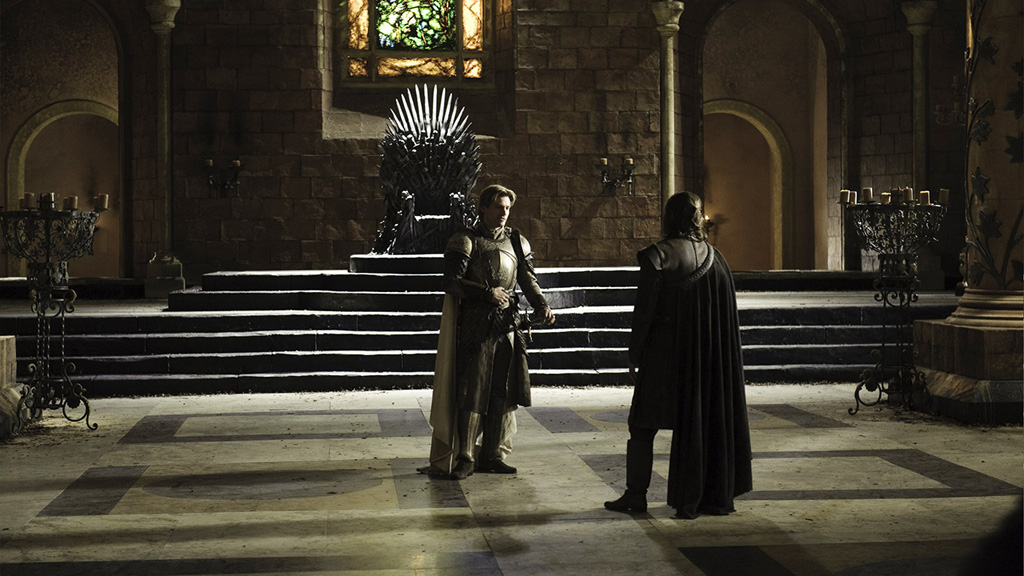
• The beautiful construction of the throne room at King’s Landing, with that incredible throne of swords. I don’t know how it’s described in the book, but in the show it’s magnificent.
• Carcetti!! Chris and I have chatted endlessly to each other about The Wire for years, so I was excited about him getting to this episode and finally seeing him. I’d have to check this, but I believe he’s actually Irish, so the accent he’s putting on for this show is as convincing as the American one he did on The Wire. Brilliant. I love when HBO finds a talented actor and uses him/her again.
• Arya looks remarkably like Catelyn… I don’t know how they found these two actresses, but what a beautiful match.

Character Development:
• Oh Joffrey, you sniveling little whiner. How much did I love the depiction of him this week as a foot-stomping toddler, with his “Oh, do I have to marry that yucky cootie girl?” while he sucked on his thumb. The scene between him and Cersei is at once a perfect portrait of a mama’s boy, but there’s a sinister undertone throughout of just how dangerous he will be, especially with her fierce encouragement. “Everyone who isn’t us is an enemy.”
• Sansa. When I first watched this episode, I cringed at how ungrateful she is, thinking man, she and Joffrey are perfect for each other. But I think she’s a more complicated character than perhaps they’re making her seem in the show. Remember, last week’s show ended with the death of her direwolf, and if those dogs become intrinsically linked with their owners, there’s something missing in her now (I don’t know how deep the link runs, but I’m assuming there’s more in the books about them?) She’s been taken ahead with Ned rather than staying back with her mother, and it’s clear Ned is more at ease dealing with men than women. He gives her a doll because she’s a girl… and girls play with dolls, right? Not when they’re teenagers looking for a husband, they don’t. She reacts harshly, and he looks out of his element and unable to deal with the situation.
• Arya. She, too, shows that side of Ned in his dealings with her. Arya is the tomboy who’s interested in swords, and you can feel the relief that washes over Ned when he talks to her because this, this is the kind of girl he can deal with. Ned: “You know the first thing about swordfighting?” Arya: “Stick ’em with the pointy end.” He gives her exactly what she wants, signing her up for her “dancing” lessons (I adore these scenes) and watches her proudly from the wings. However, that final scene in the episode grows dark when we hear the clash of steel on steel in his mind as he watches his daughter pretend killed… what was he thinking there? Is he remembering the great battles? The death of his sister? The death of Targayren? The death of the woman who gave birth to Jon Snow? I’m intrigued, and perhaps the readers know these answers, but I like the subtlety of the scene.
• If winter itself could be a character, then we get a sense in this episode of just how long and awful the winters can be, both from the old lady telling her ghoulish tales to Tyrion talking about how many winters he’s seen in his lifetime. God, I think Canadian winters last an eternity, but three years? Talk about Seasonal Affective Disorder.
• Daenerys is pregnant, and she’s becoming more confident and powerful. The scene where she leaves her horse only to be followed by the horrible Viserys is brilliant. He’s as vile as Joffrey, and watching him being choked by the whip is nothing short of AWESOME. It’s trumped only by the guy who choked him (someone whom Viserys sees as a slave) saying, “You? Walk.”
• One final question for Chris (that I meant to ask last week): That guy who’s always talking to Daenerys (I can never pick up on his name), is he the same in the book? Does he give the Dothraki backstory throughout, or are they using him as a convenient Johnny the Explainer character in this show?

And now… here’s Chris Lockett to clear up many questions:


And here we are at King’s Landing—as the caravan enters its gates, I keep hearing the Star Wars line—“You’ll never find a more wretched hive of scum and villainy”—running through my head. Ned has no time to rest before being thrown into the snake pit, having a confrontation with Jaime Lannister in the throne room in which we get some background—how Ned’s father and brother were killed by the previous king Aerys Targayren … and how Jaime was the one who killed him, despite being sworn to protect him.

This particular confrontation does not happen in the novel, but this episode departs more from the book than the previous two have. Departs in detail, but not in spirit: many of the set-pieces making up the episode—Jaime and Ned, Robert and Barristan the Bold exchanging war stories, Cersei tending Joffrey’s wolf bite—are invented, but for the purpose of clarifying themes and conflicts and character traits that the novel develops more gradually. On first viewing, it was a bit off-putting; on second viewing, I appreciated the artistry of it. The characters are deepening and the stakes are getting higher.

The title of the episode is a little misleading, considering that we don’t see a huge amount of Jon Snow. Also, we don’t see Daenerys until thirty-five minutes in. Most of the action unfolds in King’s Landing, with a fairly heavy emphasis placed in history and background—in particular, Jaime Lannister’s act of treason in killing the previous king is revealed as something more ambivalent than most of the characters would seem to want to think. Both Robert and Ned obviously hold Jaime in contempt for such a flagrantly dishonorable act, and both express their fundamental distrust of him because of it. However, we get hints of their hypocrisy: Robert has his throne in part because of Jaime’s supposed dishonor, and Ned rebukes him both for not acting to save his father and brother when the Mad King tortured and killed them, and subsequently killing Aerys Targaryen. You can’t have it both ways, Ned—but then, that is the contradiction of Eddard Stark’s painfully rigid sense of honor.

All in all, yet another excellent episode. Some more thoughts:


New Characters
This episode added a bunch of new faces to the ensemble. As a frequent complaint of those unfamiliar with the books has been the difficulty of keeping names straight, here’s the episode three primer:

• Varys the eunuch—The Spider, the master of whispers. Basically, the clearing-house for intelligence gathering at court. Varys knows everything that is going on, usually before it happens. Case in point, Catelyn’s “secret” arrival in King’s Landing.
• Renly Baratheon—The king’s youngest brother; handsome, louche, and a bit of a gadabout.
• Grand Maester Pycelle—Shrewd and canny, and ostensibly a font of wisdom.
• Petyr “Littlefinger” Baelish—Master of Coin, nicknamed Littlefinger because his family holdings are on the smallest of a cluster of peninsulas called The Fingers. He was once in love with Catelyn when they were youths, and dueled Brandon Stark, Ned’s older brother, when she was betrothed to him. Littlefinger lost, but Brandon Stark spared his life at Catelyn’s request. Baelish his own game, and is one of the slyest players in King’s Landing.
• Allister Thorne—Master at Arms at Castle Black. A thoroughly unpleasant character.
• Lord Commander Mormont—Father of Jorah Mormont, Lord Commander of the Night’s Watch.
• The boys at the Wall—We meet Green and Pyp, who ultimately become Jon Snow’s friends and allies.
• Barristan the Bold—Legendary knight, who even in his advanced age is renowned for his fighting skills.
• Lancel Lannister—Cousin of Cersei and Jaime, one of the many Lannisters inserted into service at King’s Landing.
• Yoren—A Night’s Watch recruiter.
• Maester Aemmon—The maester for Castle Black; ancient, wise, blind.
• Syrio Forel—Arya’s “dancing master,” a master swordsman from the Free City of Braavos.


Best Lines
• “War was easier than daughters.”
• “I hate your stories!” “I know a story about a boy who hated stories.”
• “Well, Lord Snow … It seems you’re the least useless person here.”
• “You’re a funny man! A very funny man!” … though obviously this one loses something on the page. Spoken however by Sean Bean as he chokes Littlefinger, he gives us a brief but striking insight into why Ned Stark is dangerous.
• “Ah, Starks … quick tempers, slow minds.”
• “They never tell you how they all shit themselves. They never put that part in the songs.”
• “I’m the First Ranger. The job is out there.” Am I the only person to hear an echo of Omar in The Wire here? “The game is out there.”
• “Here, a man gets what he earns. When he earns it.”
• “Boy, girl. You are a sword. That is all.”


What They Added / Changed
• “I haven’t played with dolls since I was eight.” Such a heartbreaking moment. Sansa still blames Ned and Arya for the death of Lady, and Ned’s clumsy attempt to make amends only worsens things. That he then shows his connection with Arya draws a line between him and his elder daughter. War, apparently, is only easier than daughters when the daughter in question isn’t interested in the arts of war.
• “You are my darling boy, and the world will be exactly as you want it to be.” Cersei here shows her doting love for her repulsive son, which stretches into irrationality, but then without missing a beat delivers a shrewd little lecture on governance and realpolitik. This is the best Cersei moment so far: demonstrating her cunning and cleverness, but also her blind spot where Joffrey is concerned.
• “Everyone who isn’t us is an enemy.” This should be the Lannister motto.
• “The boy won’t talk. And if he does, I’ll kill him. Him, Ned Stark, the King, the whole bloody lot of them, until you and I are the only people left alive in this world.” In the books, we only start to see the nature of the interaction between Jaime and Cersei in book three, when Jaime starts to get his own POV chapters. But they nail it here—Jaime’s ruthlessness emerges in this chilling declaration, articulating his single-minded devotion to his twin. Incidentally, the bit about the singers making a ballad about “The War for Cersei’s Cunt” is a GRRM line that comes in book three (I think … it might be book four).
• Robert and Barristan the Bold exchanging war stories. I did not at first care for this scene, and then on second viewing turned completely around on it. I love that the impression you get at first is that they’re talking about losing their virginity … because, in a way, they are. As mentioned above, we get a better sense of history and background, especially when Robert calls Jaime in to taunt him. It is also a lovely way to introduce Barristan Selmy, who develops into such a great character as the books progress. And Lancel! Who looks, if possible, even more prissy and whiny than Joffrey.
• The top of the Wall. In the books, the Wall is described as simply being a flat expanse “about as wide as the Kingsroad.” Here, they’ve turned it into a warren of trenches, much like the battlements on the top of castle walls.
• Yoren. Odd, this—in the books, Yoren is described as sallow, laconic, and dour. They’ve obviously decided to go a different route here in making him a hale and hearty kind of fellow.
• The exchange between Benjen and Tyrion. Between this conversation and Ned’s interactions with Littlefinger, we begin to see where Starks have a reputation for being prickly. At the same time, Benjen’s speech about what lies north of the wall is (forgive me) chilling. One of the things this episode does is set us up for what is to come: the emphasis on the dangers of the coming winter gets almost a little heavy-handed.
• Ser Jorah talking swords with the Dothraki. I loved this little exchange, a great summary of the difference in how Westeros and the Dothraki approach war and battle. Curved blade versus straight, speed versus power. And then at the end, that suspicious departure as Jorah learns that Daenerys is preggers … hmm ….


What They Got Exactly Right
• The Small Council. The dynamic of the council was pitch-perfect, and Robert’s profligacy with the royal treasury yet another revelation about his efficacy as king. Three million owed to the Lannisters? That’s not good.
• Ned and Arya. The scene between them was poignant, more so as it comes just after his epic fail with Sansa. Arya, we see, is Ned’s daughter to the bone, and he is much more at ease talking to her and being a comfort. That he not only lets her keep Needle, but then gives her lessons in swordsmanship shows just how simpatico they are.
• Littlefinger! I’ve said it before and I’ll say it again—I freakin’ LOVE Aidan Gillen. He was brilliant on Queer as Folk (the original British version), and even more so as the altruistic councilman turned politically savvy mayor Tommie Carcetti on The Wire. Littlefinger is a perfect role for him, and he plays it beautifully. We see, all at once, his need to impress and his shrewdness. A brothel is certainly a good place to hide Catelyn, but he so obviously wants to impress her with his success and/or make her jealous by being surrounded by beautiful half-naked women. Alas for Petyr, she is neither.
• Old Nan and her stories. Gods, that one gave ME chills. The woman they have playing Nan has her voice and tone down perfectly.
• Ned’s instinctive moment of violence with Littlefinger outside the brothel. As mentioned above, Sean Bean gets this perfectly. You understand why he has so frequently been cast as bad guys—he can be utterly terrifying, and there’s something about his intonation (combined with that accent) that makes you realize just how dangerous Ned Stark can be.
• Jon Snow practicing in the yard.
• Viserys freaking out on Daenerys. YES! The moment the whip curls around his neck and he lies gasping for air, I won’t lie, is deeply, deeply satisfying. And then when Jorah deliberately ignores his order to kill the Dothraki. Humiliations galore.
• Syrio Forel. In the book he is bald as an egg, but otherwise everything about him is spot-on—his accent, his words, his movement, his expressions. His grin when Arya describes the sword as a needle is worth the price of admission.

Answers for Nikki
• The Iron Throne: yep, they’ve done a very good job recreating the throne as it’s described in the books. The story behind it is that Aegon “The Conquerer” Targaryen, the first Targaryen king who united the Seven Kingdoms, had it made out of the swords of his defeated enemies.
• The direwolves do indeed have something of a connection to their humans—especially Bran, but that only really gets explicated in later books.
• The guy who’s always talking to Daenerys is Ser Jorah Mormont, an exiled knight. He went into exile because he broke the law in selling some poachers to a slaver, and it was Ned Stark he was fleeing from. And yes, he’s more or less the same in the book. He offers more in the way of exposition on the show than in the novels, but not too much. He is, incidentally, the son of the Night’s Watch commander.
• Littlefinger and Catelyn: in the books, Petyr Baelish was fostered with Catelyn’s family. The romantic attachment goes one way: Littlefinger was/is in love with Catelyn, but as she said in this episode, she has only ever thought of him as a little brother.

Tuesday, May 03, 2011

Buffy Rewatch Week 18

3.16 Doppelgangland
3.17 Enemies
3.18 Earshot
**For more, read along on pages 206-210 of my Buffy the Vampire Slayer companion guide, Bite Me.


Welcome to Week 18 of the Buffy Rewatch, and three excellent episodes that all look at the difficulties of being a teenager... both human and vamp.

First, a slice of cheese from our resident BtVS music expert, Janet Halfyard!

The death motif is building up towards the season finale, specifically in relation to Faith as a threat to Buffy. There are lots of other things I could talk about now, but that would be greedy (and possibly boring). In “Doppelgangland”, right after the credits when the Mayor says to Faith “Let’s kill you little friend”, there is it again, large as life (or death). Then in “Enemies”, it becomes part of an episode theme for Faith: we hear it first when she goes to Angel, apparently seeking help form the one person who might understand what she’s going through; but the music is a big clue that she is not to be trusted, that she remains a threat. The motif is embedded in the theme (its second phrase); we get it again when Faith comes back to try to seduce Angel for the second time; and finally when we discover that Faith has been tricked by Buffy and Angel.

(I know I said I wouldn’t, but right at the end of “Enemies”, the first few notes of the original love theme act as a tag to “This is what is left” when Angel asks if Buffy is still his girl and she replies “always” [sob])

Thanks, Janet! Our first episode this week was “Doppelgangland,” a personal favourite of mine (if only for that adorable quick wave that Willow gives to Oz at The Bronze to assure him she’s not Vamp Willow... Alyson Hannigan puts in a stellar performance in this one, showing how she can play two entirely different characters). A couple of weeks ago you met Suzie Gardner (author of the Glee book), who talked about “The Wish.” Now she’s back to discuss the other half of that episode, “Doppelgangland.”

So, tell us, Angel — how alike ARE vampires and their original mortal selves?: A look at Willow and VampWillow in "Doppelgängland"


VampWillow is back, so obviously, I am, too! Last time around when I wrote about "The Wish", I mentioned my huge love for Willow's alternate self, but in this week's "Doppelgängland", things get even more interesting. Near the end of the episode, Angel starts to correct Buffy's statement that vampires don't retain any of their original human personality traits, which can only get one thinking about just how many similarities there are between a person and their doppelgänger, a human and a human-turned-vampire.

For Willow, it originally does seem like her and her counterpart are complete opposites. The entire first half of this episode emphasizes how Willow is often seen as a pushover, "Old Reliable" as Buffy calls her. She's constantly doing whatever anyone wants of her, be it Buffy, Xander, Giles, Principal Snyder or dumb jock Percy. VampWillow, on the other hand, quickly and easily becomes the leader of a new vampire gang, showing that she's definitely not the type to get walked all over. But nevertheless, Willow did show some inner strength and power by taking on her doppelgänger's persona and attempting to lead the charge in the Bronze. What Willow continued to prove, in fact, is that her leadership and strength comes from a much nicer place than VampWillow's does — while her doppelgänger shows her strength by hunting and killing, the original Willow shows her strength through compassion. Telling Buffy not to kill VampWillow was an incredibly strong and difficult decision, but one that ultimately shows Willow's kind heart, not a pushover heart, but one that's kind and strong in her convictions when necessary. In essence, it seems as though Willow and VampWillow have both developed their strength based on their circumstances and environment — one version could fairly easily become the other, should their situations be changed.

Of course, those of us who have watched Willow's development throughout the seasons as she gets deeper and deeper into the black arts, know that the Willow of "Doppelgängland" and VampWillow have much more in common. While VampWillow shows her strength outwardly with her vampiric abilities, our Willow later moves to showing her strength outwardly as well, just with the help of her witchy talents. In fact, by the time Willow goes completely off the deep end near the close of season 6, we see that her evil-ness has hit the same point as her vampiric counterpart: her last words to Warren before she kills him are VampWillow's trademark, "Bored now." And, just because I can't help but mention it, the line where Willow says that her doppelgänger is "kinda gay", is pure gold when you know that Willow herself will be, too, in just a little while.

In comparing the two Willows, the most interesting scene is when Willow impersonates her evil self and infiltrates the Bronze. Despite her initial attempt to seem set on the kill, Willow soon begins musing about how her mortal self is a weak pushover. By having Willow disguised as VampWillow analyze Willow...well, it's confusing, but also rather brilliant. You can see that our girl is enjoying being in this more powerful role, but it's clear that she's nervous about it, too — her little wave at Oz perfectly shows her mixed emotions. She seems to somewhat envy the strength and confidence of her doppelgänger, but she's afraid, too. There's a definite tease at some future Willow personality development with this episode — we're just going to have to wait and see how much of VampWillow's traits she decides to try to take on.

And, before I go, how about some favourite quotes (because this episode is hilarious)?
Willow: Aren't you sort of naturally buff, Buff?

Willow: No, it's fine. I'm 'Old Reliable'.
Xander: She just means, you know, the geyser. You're like a geyser of fun that goes off at regular intervals.
Willow: That's Old Faithful.
Xander: Isn't that the dog that, that the guy had to shoot...
Willow: That's Old Yeller.
Buffy: Xander, I beg you not to help me.

Giles: She was truly the finest of all of us.
Xander: Way better than me.
Giles: Much, much better.

VampWillow: Well, look at me. I'm all fuzzy.

Willow: Would that mean we have to snuggle?

***

Thanks, Suzie! Next up this week was the episode, “Enemies,” and this week’s guest host to discuss the ep is... me! This episode is easily the turning point, where Faith goes somewhere and can’t turn back, where she once and for all becomes the enemy of the Scoobies. And yet, I can’t help but feel sorry for her. Earlier in the season, Xander joined forces with her to help kill Angel. In “The Zeppo,” they slept together. There was always a sense that she was separate from the rest of the Scoobs and that she might end up bringing Xander with her, but in this episode it’s clear she’s on her own. As I said in my book, the main difference between Xander and Faith when it comes to friendships is, “Xander values his loyalty to his friends above everything else because he has their acceptance, while Faith is so busy craving acceptance that she’ll stab people in the back to get it.” Faith has said her mother is dead, then suggested her mom was a deadbeat (but very much alive) and in this episode she goes with that second one and paints a dark picture of what her difficult life has been like.

As I said to my husband while watching “Enemies” this time, what I love about the Faith storyline is that Joss Whedon not only came up with this entire mythology of a girl who was chosen to be humanity’s safeguard and protector against the forces of darkness, but then showed us an example of one who went bad. It’s inevitable... with that much power comes responsibility, but as we all know, power corrupts.

I have to admit, the first time I saw “Enemies” I was PRAYING that Angelus would return, and when I thought he had (for I, along with Faith and many other viewers, was totally duped), I was thrilled. I’d been getting a little tired of the morose, brooding, Tai Chi-practisin’ vamp and I wanted something with more bite. The scenes of not-Angelus prancing about are very important for the overall storyline, because not only is it fun to catch a glimpse of him again, but it confirms that Angel is very aware of Angelus’s actions when he’s trapped inside the demon body. Not only that, but considering the fact that Angel was actually just pretending to be Angelus in this scene suggests that he actually meant to hurt Buffy with some of those words. He didn’t hold back, even though a slightly less harsh performance probably would have still put one over on Faith. But instead, he let Buffy know how he felt being sent to Hell, and he made sure he snogged Faith every chance he got, probably letting off some steam at seeing Buffy “moving on” at the beginning of the season after having sent him to Hell. He reassures Buffy at the end of the episode that he didn’t mean those things, but she’s caught a glimpse of the monster who terrorized her family and friends again, and has realized she’s been kidding herself if she thinks that monster will forever stay at bay.

Now, as of the writing of this, I’m still waiting on the last entry from our other guest host, so I hope I don’t repeat what she’s going to say by giving you a bit of the background on “Earshot.” (Much of it is outlined on pages 208-209 of my book.) If you were watching BtVS when it first aired, then you remember the series jumped from Enemies to Choices, with no Earshot in between. That’s because on April 20, 1999, two students walked into Columbine High School in Littleton, Colorado, and shot up their school (killing 12 students and a teacher) before killing themselves. “Earshot,” about a student who’s had it with being mocked and situates himself in the clock tower of the school with a rifle, was scheduled to air one week later, on April 27, and the WB thought it was simply too soon. In the midst of people blaming Marilyn Manson and violent videogames and TV shows and movies for the shoot-em-up (rather than, you know, two disturbed individuals), it almost appeared as though the WB were saying, “YES, shows like this one can definitely lead to shooting up a school, so let’s pull it.” But I think, to be honest, it probably was too soon to show it, and Joss Whedon agreed with the decision.

That said, they held off on showing the episode until September 1999, when it was actually making a very important point about what happened at Columbine, and how painful the high school experience really can be. The show was entirely finished before the massacre happened, so the writers were being pro-active in noting that this teen angst can become lethal, and I wish that, rather than burying it a week before the S4 premiere, they ran it with a splash and opened up a discussion, for this episode pretty much nails the real problem behind a tragedy like Columbine in ways that a bunch of right-wing pundits simply couldn’t.

What I love about “Earshot” is that incredibly important idea – one of the most realistic lines of the entire series – that everyone is in pain. We think the cheerleaders and jocks have it made, but they don’t. They have pressure on them to be popular, and are expected to be clueless and pretty. (And heterosexual.) Nerds are treated like outsiders and constantly picked on and made fun of, which is why it’s always harder to sympathize with the popular kids who bully the underdogs, but they still have their own problems. A nerd might be unpopular in high school, but he or she might go home to a loving family who supports them and helps them ultimately become successful. A jock could be incredibly popular in school, but go home to a troubled home life where he lives in fear.

So, while I agree that it was right to delay the episode, I think it was also one of the most important messages people needed to hear in that moment – rather than look at outside forces like music and TV and videogames and films, why not look at the structure of high school itself? Everyone is pressured and stressed out and having to figure out what they’re going to do for the rest of their lives, and it’s a horrible, hellish place. Of course Sunnydale High was built on a Hellmouth... can you name one high school that isn’t?

Now, I’ve seen “Earshot” over 25 times, for reasons that I’ll explain when we get to the S3 finale, Graduation Day. But for now, when you’re watching “The Prom” for next week’s rewatch, imagine not having seen “Earshot,” and you’ll realize how confused we viewers were when we watched it live in 1999.

Also, considering the Sookie Stackhouse novels were first published in 2001, I've often wondered if Charlaine Harris watched "Earshot" and from this episode, got the idea for a woman who can hear people's thoughts and who falls in love with a vampire.

This week’s third guest, Tanya Cochran, last joined us to recap Bad Eggs/Surprise/Innocence, and here she is again to talk about how Enemies and Earshot come together. Welcome back, Tanya!

“Enemies,” “Earshot,” and Empathy: How Buffy Makes Us Feel

I decided to re-watch only “Enemies” and “Earshot” for this week and see what connections materialized. As usual, Whedon and team demonstrated their wickedly awesome myth-making skills. Purposefully or not, these two single-word-titled episodes work beautifully together, though they did not air side-by-side as originally planned.

Most of you probably know that “Earshot” was set to follow “Enemies” in April 1999 but was delayed until later that year, in September. A week before the air date for “Earshot,” two young men carrying guns and other weapons entered their Colorado high school and opened fire, in the end taking their own lives in addition to thirteen others. The Columbine event shook the United States. In the DVD interview for the episode, Whedon himself says that not showing it was “the right thing to do.” Though I don’t completely agree (keep reading), years later watching “Earshot” and “Enemies” in sequence can still teach us something essential about human pain and the need for empathy.

Each year at my college, we celebrate Peace Week, seven days set aside to focus on the pillars of peacemaking: dialogue, justice, forgiveness, and reconciliation. This year, students and faculty participated in an activity called “Crossing the Line.” In the auditorium, we stood along a duct tape line on the floor. Then a student organizer began to read statements that describe the human experience. If we could say “yes” to anything she read, we were to step over the line. The words came and we moved: “Cross the line if you’ve ever been bullied.” Step back. “Cross the line if you’ve ever felt overwhelming loneliness.” Step back. “Cross the line if you’ve ever been raped or know someone who has been raped.” Step back. “Cross the line if you’ve been called a racial or ethnic slur.” Step back. The point of the activity, if everyone is honest, is to see how alike rather than different we are. The point is to catch at least a glimpse of what it might be like to be someone else. The point is to experience, even for a moment, a little empathy. For me, that’s exactly what Whedon and team do in “Enemies” and “Earshot.”

In “Enemies,” my heart breaks for Faith, the young woman who too flippantly tells Angel, “Mind if I skip past the Mom-never-loved-me part and get right to it?” According to Whedon, Faith is the first human monster Buffy and friends must face. The sad truth is that the monster within her, though it will strike out at others many times, is a self-devouring one. We know how self-destructive Faith is when she confronts a chained-up Buffy toward the end of the episode. She tells Buffy that her mother was essentially absent, bound to a bottle of booze. All Faith wanted was someone or something to love (and love her back, we assume). So no puppy—symbolically, no real childhood—for little Faith. But she survives, she grows up, she finds that she has a calling, a purpose. In Sunnydale, she’s needed. At first. Her perspective quickly changes. She does her job as a slayer, but Buffy is the Slayer. She works even harder to be and do good, but Buffy gets the thanks. Everyone wants to know, “Why can’t you be more like Buffy?” There is so much anger-masked pain in her voice when she exclaims, “You get the Watcher. You get the mom. You get the little Scooby Gang. What do I get? Jack squat.” Most of us watching can understand. Also, Faith isn’t all together wrong in her assessment, which is why we feel good about Mayor Wilkins, evil though he is, loving and caring for Faith: he offers his friendship and protection; he gives her a home of her own; he buys her a sundress, makes sure she drinks her milk, and encourages in her a sense of self-respect and self-discipline. More than anyone else in her life, he wants to make her happy: “Two words: miniature . . . golf.”

In ways that are likely unintentional yet nonetheless profound, “Enemies” foreshadows “Earshot.” In “Enemies,” the interior becomes exterior, what is buried deep is dug up. Faith’s fear, pain, and rage are unearthed; after this episode, there is no doubt that she fights on the side of Mayor Wilkins. Giles calls her what she is: “a rogue Slayer.” Buffy punctuates Faith’s fear when she says, “There’s a word for people like you: loser.” In many ways, “Earshot” is all about feelings of loser-ness being exposed, at least to Buffy. At first, the aspect of the demon that Buffy inherits seems entertaining. Now she can use her thought-reading insight to predict her enemies’ moves, Giles excitedly declares. “Way better than that,” replies Buffy. As Whedon notes, however, the funnish novelty of knowing that Xander is a typical teenage boy who thinks about sex pretty much all the time or looking smart in English class by stealing answers to questions about Shakespeare from the mind of the smarty pants on the front row wears off quickly. The aspect of the demon is no spiritual gift; it’s “something darker,” says Whedon.

As Jane Espenson explains, psychic ability in high school only means being surrounded, engulfed by pain. When Buffy hears a promise of fatal action among the already-overwhelming misery, the coolness of the demon aspect is certainly over. A death threat is serious, serious business. One reason I believe “Earshot” should have aired in order is that it acts as commentary not on school violence so much as on the human experience. The twist in the episode is that Jonathan, as abused as he has been over the years, doesn’t ever consider taking the lives of others. His pain doesn’t require others’ sacrifice. He just wants to stop feeling, stop feeling ignored and bullied and small and weak and stupid and lonely and geeky and . . . Who can’t understand, even for a fleeting second, that a bullet might offer respite.

For me, “Earshot” is ultimately about bringing the ugliness of humanity to the surface—again, the interior becomes exterior. Not just for the sake of doing so. Not just for viewers to gawk. But to make us feel. To feel for each other. The missed opportunities of not juxtaposing “Earshot” with Columbine are that (1) the episode actually raises awareness and empathy rather than glorifies violence and (2) the culprit of the planned violence isn’t a student but a school staff member, highlighting briefly but significantly that the pain doesn’t always go away after high school. “I never knew you had so much rage in you,” Buffy tells Faith in “Enemies.” She might have said the same thing to the cafeteria cook in “Earshot.”

Of course, the rage itself isn’t inherently evil. As Whedon often reminds us, it’s what we do with our feelings that matter. Let’s face it: we all suffer and we all act like we’re not suffering in order to survive. Life’s a stage . . . or a show, and we all play our parts. The hardest thing about life is living. But that’s what we must do. A bullet might seem to offer respite from pain, but it also kills any chance of redemption, any chance at the joy of healing.

In “Enemies” and “Earshot,” Whedon and company teach us something essential about human pain and the need for empathy. A gun shot or poison could end the suffering we experience. But that choice would halt life in the midst of our suffering. Not a very good ending. The more courageous choice is to live, to outlive the pain. To keep on feeling.

Next week: Kristin Romanelli joins us to discuss “Choices” and “The Prom,” two stellar episodes that precede the season 3 two-part finale.

Buffy Rewatch Week 18: Spoiler Forum

And once again, here is the forum where you can discuss Buffy and Angel without fear of spoiling any of the newcomers. To expand on what I said in the above post, imagine watching The Prom and listening to Jonathan's speech about Buffy, not knowing that she was the one who talked him down from the clock tower. I remember sitting there saying, "Wait... what? How did Jonathan know about what she does??"

"Earshot," of course, also now puts me in mind of "Superstar" and what Jonathan will become in season 6.

Sunday, May 01, 2011

Fringe: "The Last Sam Weiss"

So, is anyone else suddenly terrified that they might kill Peter off the show? I don’t think I’ve felt that kind of adrenaline while watching a TV show in a really long time. As Peter was mounting the stairs and we saw the flashbacks of his life, my husband was convinced that was the end of him. “I mean, they have Leonard Nimoy in the show,” he says. “Isn’t that a hint that, like Spock, he’s going to sacrifice himself to save everyone?” “OMG, and Spock did that at the end of the third movie, didn’t he, and this is the end of the third season?” I said. Zoiks.

But with the very end of the episode, with Peter being zapped 10 years into the future, I’m thinking nope, he’s still vitally important. I’m really REALLY hoping they think he’s vitally important because I can’t bear for him to go. On the one hand, I’ve become very attached to him, and even at the beginning of the series when I was still unsure of it, I thought Walter was a caricature, Olivia was a bit wooden, but Peter had a lot of charisma and I loved the way Joshua Jackson played off the other characters.

But on the other hand, imagine how gutting that would be for everyone. The reason the worlds are shattering is because of Peter and Walter’s love for him. So if Peter were to die, what would happen to the worlds then? What would Walter and Olivia do? They’d both be as broken as the worlds around them, and how would they piece those lives back together? Peter is significant in that there’s only one of him, and I’m curious to see in the fourth season if they ever suggest that will have an effect on the other half. Broyles now has only one version of himself, whereas we have two Olivias and Walters. Interestingly, there’s only ever been one William Bell, something that’s never really been explained. Did alt-Bell die in childhood? Or was he never born? If the latter, how is that possible? I’ve always wondered if there’s some link between Bell and Peter, like a Sam Weiss kind of thing. Hm.

This week’s episode was AWESOME, and I cannot wait for next week’s season finale. My favourite scene was when Walter was talking to Olivia, and told her that if she could see herself the way he does, she’d realize her amazing potential. In this scene we look into Olivia’s eyes as she looks back at Walter, and we see the same little girl that he does, and everything she’s been through and how she’s been able to contain her powers, rather than having them take her over the way the other cortexiphan subjects did.

Highlights:
• I loved the multiple Sam Weiss explanations that Olivia got in the crypt. Robyn Hitchcock should write a song called “My Sam Weiss and My Dead Sam Weiss.”
• Those lightning special effects were awesome, especially when we looked out from that balcony and saw them all over the hill and the town. Did you notice that when they hit something it turned black and smouldered? Brilliant.
• Olivia showing her badge to get into the museum, followed by Sam showing his, “Sam Weiss. Patron member since ’82.” (Anyone else wonder what century he meant? Perhaps 1882, and the membership belonged to several Sam Weisses before him.)
• Sam tossing the vase and saying, “I work in a bowling alley.”
• Olivia in the drawing! GASP!!!
• Peter to Walter: “I know you’re not the Secretary of Defense. The sweater is a dead giveaway.”

Did You Notice?:
• The glyphs spelled MULTI.
• Someone asked me last week if I noticed that the guy playing Sam Weiss was the same guy playing Sean Garrity, the drama instructor on Community. Kevin Corrigan is one of those actors who has been around for ages, despite his relatively young age. The first movie he was in where he really made an impression on me was Buffalo 66, where he played the put-upon friend of Vincent Gallo’s character, being called at all hours of the night. He was in Living with Oblivion with Steve Buscemi, and more recently starred in The Fan with Patton Oswalt. In between he’s probably been in over 100 indie films. He was in the TV show Grounded for Life with Donal Logue, another indie fixture, and was in The Departed and Superbad. He’s one of those actors who, if you see enough indie films, you begin saying, ‘Hey, it’s THAT guy!’ I think he’s amazing, and when he first appeared as Sam Weiss a couple of years ago, I was very happy to see him (and he’s brilliant on Community, by the way).
• In the car that the family was driving at the beginning, if you look at the license plate it has 4s and a 23 in it. Lost numbers!
• Poor sweet wonderful Astrid, she’s always at the mercy of Walter and his whims, but also acts like a mother figure to him. I loved that she had that giant set-up with the kite and the key, and when he figured things out he simply said, “Pack it up, Astrid!” Oh, OK. I’ll just “pack up” this giant table and equipment.... It’s probably an hour-long job to do so, and he’s acting like she can just toss it into the trunk.
• When Sam says “Good luck, Olivia,” it sounded more final and less casual than she took it.

Any Questions?:
• Why 2021? What has happened to Peter in that reality? He’s definitely in our world – in the other world, September 11 didn’t happen and the Twin Towers still stand. If it’s a certain future, then it means he won’t die with the machine and instead lives another 10 years, but is he being given a glimpse of it or has he actually been zapped a decade into the future?
• Will there be any connection between Peter’s momentary lapse of memory and this? There had to have been a reason for him to have lost his memory of this world and be convinced that his dad was Walternate... why was that? Was it just a writer’s ploy to get him to NY?
• What is happening to our world in 2021? Is it a result of the machine? The two worlds collapsing?


And also...
I mentioned a few days ago on my Facebook page that I'm working on a new book on Fringe as the editor, and so far it's amazing and has changed the way I watch the show. People have been asking me to let them know when a good Fringe book comes along, and this one is it. Amazon is taking pre-orders now, and the book will be out in October.