Thursday, April 19, 2012

What Happened to my Once Upon a Time Posts??

I get a lot of emails from people who read my blog (and thanks to everyone who takes the time to do so!) And in the past three weeks, my blog-related emails have probably quadrupled. Has there suddenly been a run on my Finding Lost books? (No, but you can make that happen… go here!) Has Joss Whedon cited me as his critical inspiration when working on The Avengers? (Well, not out loud, but…) No.

I stopped blogging about Once Upon a Time. And people kinda noticed.

So, I should have just come here and explained why I stopped instead of answering that question individually over and over and over again in emails, but I didn’t. And so here I am, explaining to all of you. Don’t worry… there’s no sinister reason why I didn’t blog on it.

I last blogged on the show with “Red-Handed,” written by the wonderful Jane Espenson. The following week was “Heart of Darkness.” I was out that night with my family, and the next night running around with all of the children’s extracurricular activities. I finally watched it Tuesday night, I think, and it was really late at night and I had come down with the office cold (that has officially gone around the office 42 times now, and made everyone sick numerous times as it just keeps evolving and changing), so I figured I’d do it the following night.

But then, I completely forgot. Because, as those who follow me on Facebook know, my family left for the Dominican for a week-long (much-needed) vacation on March 23, and we were packing and getting things ready for that every evening, and it just fell by the wayside.

And… there’s the reason why I missed the March 25 episode: I was in the Dominican. So, with the conviction that upon my return on March 30 I’d watch the episode from the 25th and do a quick blog on both, I sat back and enjoyed my vacation, even though — sadly, this is absolutely true — the Kardashians showed up the last day we were there because they’re filming the next season of the show at the resort we were staying at. Their production team was there the previous day, swarming the poolside and flicking their cigarette butts all around while little children were playing in the pools. It made for a good story after, but I honestly thought our timing couldn’t have been better. We checked out as they were checking in.

ANYWAY. So then we came home, very tired, put the kids to bed, and then we passed out in our own bed, not even turning on the TV. (You know Nikki’s tired when…)

The next morning I flipped on the TV and clicked on the PVR button, and it wouldn’t show the PVR guide for some reason. I reset the PVR, and when everything was back up and working I clicked again, and there it was. Everything seemed to be in order – the last things recorded were The Soup and Fringe, which should be the last things recorded on a Friday night. (Yes, I know The Soup moved to Wednesdays but because it’s been a Friday night tradition for so long, we still record it then.) But then I paused, and felt a cold shiver go down my spine. “Why is there only one Fringe??” I asked my husband. The panic began rising as I clicked on it and realized it was dated the week before. As was The Soup. And Community and 30 Rock and OH MY GOD WHAT IS HAPPENING??

I’ll tell ya what happened. Bell PVRs (this is Canadian speak for DVRs or TiVOs) have a very limited shelf life. Our last one pooped out one day after our two-year agreement ended. This one has apparently given up a week after the warranty ended. Well played, Bell. Well played. Maybe I should look into Rogers.

Anyway, sure enough, it appeared the last things my PVR had recorded were on March 23rd – the day we left – and (HORRORS!!) it had just shut itself down. For the week. It wasn’t full – despite my copious TV viewing, it’s a 200-hour hard drive and still had a good 50 hours open on it – it just turned itself off. And now I have to manually update it once a week so the guide keeps going forward. But long story short, everything I had set to record that week was gone. The new Fringe. Downton Abbey. 30 Rock. Modern Family. The freakin’ season opener of Mad Men. The Big Bang Theory. Saturday Night Live. Awake. South Park. Canada's Got Talent. The season finale of Alcatraz. Community. Ringer. Grimm. (Behold all the TV I watch and don’t have any time to blog about… it’s because I’m always about 2 weeks behind on everything and then it’s too late to write about it. Since then I've added about five new things to it.)

And… Once Upon a Time. Sigh.

This past weekend I finally sat down with my daughter and watched the magnificent “Hat Trick,” with the two of us throwing out guesses of who the guy was (I guessed Mad Hatter as soon as he was holding tea and we were both squealing when it turned out to be him – I’ve passed on my love of Alice in Wonderland to her) by streaming it on the network’s site, and then flipped back over to the TV to see “The Stable Boy.”

So, I’m finally caught up. And while I’m actually out of town again this weekend (I’m giving a paper at the Festival of Faith and Writing at Calvin College on Saturday on Lost and issues of faith on the show), I’m hoping to be able to post something on Once Upon a Time soon after, and finally be back up to date with everything. But very, very briefly:


“Heart of Darkness” :
• I loved the idea that the one thing Rumpel can’t bottle is love, but that he manages to do it with Snow and Charming.
• The image of Snow White singing to the bird like in the Disney movie, only to try to kill it, was hilarious.
• If that height chart in the police station is correct, Ginnifer Goodwin is taller than me! But she looks so tiny…
• I was surprised to see Jiminy Cricket; we haven’t seen that guy in AGES and I’d like him to come back more regularly. I’m hoping in S2 we get a backstory of his life with Geppetto.
• The writer comes to Henry and tells him he’s here to try to show other people the light. Intriguing!
• He tells Henry that people like us go on faith; others need proof. He and Henry are the Lockes… they need to convert the Jacks.


“Hat Trick”
• Holy hotness, Mad Hatter. Desmond, you may have been replaced. (I laughed out loud when my 7yo daughter said, “Mommy… don’t you think he’s kind of ugly?” with her nose all wrinkled up in disgust. I said, "Actually, I think he's quite handsome!" She looked at me like I had the Worst. Taste. Ever.)
• Those hats were divine.
• This episode was intriguing because of the fact the fairytale being referenced wasn’t clear, and the guessing game took much longer. What a WONDERFUL way to retell the Wonderland story.
• Wonderland!!!! Fantastic. PLEASE have more of that.
• Why the veil over the queen? What could be hiding there?
• How did the Hatter disappear? (Did he just vanish and reappear in his hat-making room again?) Please please please please be back.


“The Stable Boy”
• Could someone just give an Emmy to the casting agent who discovered a little girl who not only looks exactly like a young Ginnifer Goodwin, but talks like her, too? That girl was brilliant.
• The actress who plays Regina has a very mature look about her (and her deep voice always makes her seem older) but I was entirely convinced when she was playing the younger version of herself.
• We finally discover that what she hates about Snow is that she caused her to leave behind her one true love and marry Snow’s father. I actually thought in the scene in the barn that it would be more than that. I thought the queen would watch her mother kill her lover, and then her own magic would bubble up so strongly in her that she’d turn and kill her mother. Then she would blame Snow for both deaths. (The constant mention of how important a woman’s mother is in her life really felt like it was leading to that.)
• Kathryn’s alive! I guess this helps Mary get out of jail free, but what happened to Kathryn, what will she tell everyone, will the curse lift, and how the heck could Kathryn’s DNA be on that heart if it turned out not to be hers? Did Regina fix the records?

I can’t wait until this week!

Coming soon: My apologies for not covering Fringe. ;)

Tuesday, April 17, 2012

Game of Thrones S2: "What Is Dead May Never Die"


Welcome to week three of my season 2 recap discussions of Game of Thrones, with Christopher “Lord Commander” Lockett. Last week Chris and I were talking about how the sex quotient seemed to have been really upped in week 2, and I don’t know how many people saw it, but SNL did a parody sketch this week of behind the scenes at HBO, talking about how the two key consultants on the show are George RR Martin, and a 13-year-old boy named Adam who keeps telling them to use more boobs. ;) So I guess we’re not the only ones noticing it.

Nikki: This week there were a LOT of stories covered, and as such it felt a little slow. But what happens in this episode is mostly exposition for what is to come. But that doesn’t mean the episode was boring – not by a long shot. I always like to open with Tyrion, so let’s get him out of the way this week by discussing his brilliant deception. To figure out which member of Council has the ear of the queen, he brings Pycelle, Varys, and Littlefinger to his office and tells each of them that he’s going to marry Princess Myrcella off to one of three different people. When Cersei later goes off on him, yelling and screaming that she can’t believe he would want to send Myrcella off to Dorn, Tyrion knows it was Pycelle who blabbed. In doing so, he gains the ire of Baelish, and the cautious respect of Varys. That said, I thought the suggestions that he would marry her to Theon Greyjoy or Robyn Arryn (that inbred-seeming child who was still suckling at his mother’s breast in middle school last season) were a little over-the-top, but then again, those kinds of marriages are probably par for the course in this world. Interestingly, Cersei’s fury causes her to shove Tyrion and knock him right over, once again reminding us that he has no physical power. But he’s driving her mad, and that is his power.

Speaking of Cersei, we also are privy to the most uncomfortable dinner scene imaginable, where she eats with Sansa and the two younger children, who both excitedly yap on about the impending nuptials between Sansa and Joffrey while Sansa looks like she’s choking down every bite of her food. Curiously, Cersei shows absolutely no sympathy for Sansa, and instead tests her, asking her how she’d feel if Joffrey killed her brother Robb, to which Sansa simply says she’s looking forward to the war being over so she can finally be wed to her beloved Joffrey. Cersei looks impressed, but there’s no sympathy, despite the fact she later reminds Tyrion that she’d been shipped off to Robert Baratheon against her will.

What did you think of this week’s episode, Chris?

Christopher: Well, I should probably begin by mentioning two errors I made in last week’s installment, one significant and the other just irritating. The significant error was in my assertion that Arya did not reveal her identity to Gendry until much later. As it happens, she did so more or less where the series has her do it. I have no excuse for this mistake, other than that I honestly didn’t remember it (my reread of A Clash of Kings is proceeding more slowly than I would like, as this is one of my busy times of year).

The other error was in referring to the traditional Iron Islands seat of power as the Driftwood Throne, where it’s actually the Seastone Chair. This one at least was just a matter of getting things confused, as the crown worn by the kings of the Iron Islands was the Driftwood Crown (at least, I’m pretty sure).

So anyway, fuckups aside … This week was pretty amazing, I thought, as we get a handful of new characters—most notably Brienne the Beauty and Margaery, Renly’s queen. The latter is bit of interesting casting—those who watched The Tudors will of course have recognized Natalie Dormer, who played Anne Boleyn. She’s somewhat older than the novels describe her, and a whole lot more perspicacious when it comes to sex. Of course … much of the Renly/Margaery marriage is left to speculation, as is the Renly/Loras relationship, and once again the series does a deft job of making the subtext text. From the looks of things, Renly’s homosexuality is something of an open secret, but as his new queen points out, all it takes to silence those murmurs is an heir growing in her belly. Kings, after all, make their own rules …

I would actually go so far as to say the theme of this week’s episode was pragmatism. It’s established for us in the first sequence as Craster returns Jon to the Lord Commander and demands that the Watch vacate his keep. Jon’s horrified tale to Mormont gives way to the even more horrified realization that his commander knows what Craster does with his men-children … and knows enough to ominously predict that Jon will see more of what he saw in the woods when the infant was taken. But when it comes to survival in the “real” north, morals are a luxury—one takes allies where one finds them, Mormont implies, and one doesn’t shrink from monsters like Craster.

But to return to Tyrion and the question of power … the little confrontation between Cersei and Littlefinger in the first episode was a nice setup for Varys’ riddle, don’t you think? Littlefinger and Cersei each come at the question of power from opposing places: knowledge as power versus power as power, and we saw in their face-off the deficiencies of both. Varys shows himself (again) to be the most nuanced thinker of the lot … and if you’ll forgive me for going all academic, he’s the Foucauldian of the lot. Power isn’t a thing one wields, it lies in discourse. I’ve always thought that the answer to his riddle (which is essentially verbatim from the novel) is that power lies in the hands of the man who convinces the others that he has it. That might take place by way of a conviction in the right of divine rule, for the king; the persuasion of money, for the wealthy man; the threat of divine retribution for the priest; or, it might be that the sellsword convinces the other with the edge of his blade. Or, more likely, some combination thereof.

Nikki: The scene with Varys was amazing, and incidentally, they pulled that as the voiceover for the first big trailer for S2, so it already felt familiar. The speech is a brilliant one, made more powerful in the delivery of it: “Power is a curious thing, my lord… Power resides where men believe it resides. It’s a trick, a shadow on the wall. And… a very small man can cast a very large shadow.” I do love Tyrion’s response: “I have decided I don’t like riddles.” I also forgot to mention how much I enjoyed the scene of Pycelle’s comeuppance, where Tyrion brings in his goon and catches him post-coitus.

Tyrion: Cut off his manhood and feed it to the goats.
Goon: There are no goats, half man!
Tyrion: Well make do!

As he leaves, Tyrion puts down a coin for the whore “for her trouble,” then pauses, looking at Pycelle in the hallway, and turns and hands her another one. My husband took the second coin to be the one to keep her silent. I took it as him realizing that servicing Pycelle was probably more trouble than just one coin’s worth.

It’s interesting you say that this week’s episode is about pragmatism; I completely agree. In my notes about Margaery I’ve not only written, “Anne Boleyn?” but, “The queen seems more pragmatic than romantic.” I don’t know how she’s portrayed in the books, but here she doesn’t seem bothered by her husband’s predilections, and instead just sees a way they can deal with it. Do the books go into any detail about how Renly and Margaery came to be married? Is there a link with the fact the king has been bedding her brother? (Or is that something we’ll discover more about later?)

Meanwhile in the Iron Lands, Theon has to choose a side: the Starks, who raised him as one of their own, or the Greyjoys, who gave him away. I really enjoyed the scene between Theon and his sister and father, where his father curses him for having some loyalty to the Starks, and Theon reminds his father that Daddy gave him away like a dog. It’s hard to argue with that: how could he expect Theon to act any differently? But if Theon is going to prove he’s a Greyjoy, that what is dead may never die, he will have to change sides.

It’s not an easy decision, however. The camera doesn’t hold on his letter long enough to tell, but if you pause the scene where Theon burns the letter you can see it’s to Robb Stark, warning him that his father is planning to attack the north with an army, and advising him to bolster up his forces to be ready for him. Theon’s instinct tells him to side with the Starks, but his pride tells him to side with his blood. I thought the setting of the scene where he’s rebaptized as a Greyjoy was stunning, with the ocean and the rocks. Beautiful.

Now, back over to Renly’s castle, I noticed you referred to the latest member of the King’s Guard as Brienne the Beauty. Is that what she’s called in the books? Is it meant as a joke? Here she’s called Brienne of Tarth. I don’t know if she’s meant to be a likeable character in the books, but I love her already. She’s a little harsh, but such a unique and dynamic character. And I’d like to find out more about the actress playing her, and if she’s really as tall as she appears on the show. Does she really tower over everyone else, or are they filming her the way they filmed Gandalf with the hobbits? Incidentally, after complaining last week about people letting kids read these books, I was on a second watch of this episode and my 4-year-old son walked in. I stopped the show, he went into the other room and played, then wandered back in, I stopped the episode, and then said, “Actually, come see two knights fighting,” knowing that there wasn’t any blood, and he’s in a knights-and-castles phase right now. He watched the fight with a smile on his face, but when Brienne stepped up and lifted her mask, he said, “It’s a GIRL? I don’t like this show,” and walked out. I have much to teach that boy. ;)

Christopher: In the novel of A Game of Thrones, we get an inkling that Renly is plotting against Cersei while Robert is still alive. At one point he shows Ned a picture of Margaery and asks if she bears any resemblance to his dead sister, and Robert’s great lost love, Lyanna. The idea, obviously, is for Robert to put Cersei aside and marry this other girl; and when Renly raises his rebellion in A Clash of Kings, he marries Margaery to cement the allegiance of House Tyrell, another of the great powers of Westeros.

In the novels, Margaery’s a bit of a mystery … she doesn’t get her own POV chapters, and is generally described as a demure, courteous girl who is fiercely devoted to her brother Loras. As I said, the series has made overt much which is just implied in the novels, and Natalie Dormer’s aggressively pragmatic Margaery is a pretty daring departure from the books. But I think it’s a wise move, all things considered: I quite like this more explicit version, especially considering the limitations of television—there simply isn’t the same capacity to develop complexity and nuance. The Renly story is mostly left to the imagination in A Clash of Kings. Here, the stakes are pretty clearly laid out, and Margaery’s matter-of-fact acknowledgement of that functions as a sharp lesson for Renly—that personal predilections and affections are at best ancillary to the game itself.

As an aside, right here is the main reason GRRM’s novels have proved so amenable to HBO … at such moments, I expect Margaery to shrug and say to Renly, “All in the game, baby. All in the game.”

Cersei provides an interesting contrast to Margaery—though the aforementioned showdown with Littlefinger, to say nothing of the smug expression on her face when she says “Power is power,” shows that she obviously imagines herself an accomplished player, she’s constantly showing herself to be at best an amateur, at worst inept. The ease with which Tyrion exposes her is bad enough for her; worse is her tantrum at the prospect of having her beloved daughter married off. But as Tyrion reminds her, princesses are an eminently tradable commodity in the game of dynasty building.

It’s a good reminder that Cersei was herself wounded by being so traded. Not that we like her any more for it, but it makes her rage at the prospect of Myrcella being married off to a probably loveless marriage more understandable.

The parts with Theon were exceptionally well done; it’s nice to see that character coming into his own. As arrogant and self-important a git as he’s been, they do a lovely job of engendering sympathy here … we realize that his time with the Starks was an ambivalent captivity in which he came to love his captors, while still harbouring resentment. And all that time he was a hostage of Winterfell, however well treated he was, he’s obviously spent his time dreaming of home and his ultimate, triumphant return. His explosion at his father and his rage at having been given away was particularly poignant, and made the juxtaposed scenes of burning his letter to Robb and being re-baptized doubly so.

As for Brienne: she is in fact Brienne of Tarth. “The Beauty” is the cruel name the men of Renly’s army have given her. I’m delighted to finally see her on the scene: she’s one of the more interesting and thought-provoking characters in the books. I won’t say much more about her, just in case the show gives us all that background.

Any final thoughts?

Nikki: I wanted to mention my love for Catelyn in this episode, how she just strides into the middle of this bit of “fun,” where the king and his queen sit on their thrones to see the knights jousting, and she stands there, defiant and confident, and says what she needs to. She ignores Brienne telling her to kneel, and when Loras tells her that if Robb Stark wanted their help he should have come and gotten it himself, she replies haughtily, “My son is fighting a war, not playing at one.” She is amazing.

Bran’s dreams have been sitting in the background of the show since early in the first season, but because they’re becoming more frequent, I’m thinking we’re going to see more about them soon.

And finally, Catelyn the Brave was nothing compared to Yoren. Last week we saw him threaten a man’s family jewels while the man held a giant sword at Yoren’s head while sitting aloft a horse, and this week he dies gloriously — with a bloody crossbow arrow sticking out of him he manages to kill FOUR men, and it takes another three to actually hold him in one place so he could be killed. (Did I mention he’s got a freakin’ arrow sticking out of his chest?!) This scene followed a long scene where he speaks to Arya about the man he wanted to kill, who had killed his brother. He tells her that every night he would say the man’s name like a prayer before he’d go to sleep, repeating it until the very name became as loathsome as the man himself, and when he did find him, he killed him and went straight to the wall. His monologue reminded me of Sawyer on Lost, who actually took on the name of the man he wanted to kill as his own moniker so he would be reminded daily of the one person he intended to kill. Watch for an allusion to this speech in the next episode.

Until next week! The last episode I’ve seen in advance, where I can promise you, if you thought you hated Joffrey before, that was nothing compared to what you’ll think of him now.

Sunday, April 15, 2012

Girls on HBO: Not a SATC Rehash

Trying to decide if you should watch HBO’s new comedy series, Girls? Worried it’s going to be too much of a Sex and the City ripoff? Well, worry no more. While a knowledge of Sex and the City is almost a necessary precursor to fully understand the subtle humour in this show, Girls is a very different series.

Starring series creator and writer Lena Dunham in the lead role of Hannah, it’s about four women who have come to NYC to find the awesome that they had watched on Sex and the City, and instead find it’s a really expensive place with not as much to offer for four regular girls who don’t look like (or have the seemingly bottomless income of) Carrie, Samantha, Miranda, and Charlotte.

The opening moments of the show give it a Rushmore feel – that awkward dinner conversation where one’s life changes completely. From there Hannah, who thought she had the world in her hands with her free internship as a copy editor, her tiny apartment she can barely afford, and her occasional hook-up with her fuck-buddy (you simply cannot call him a boyfriend), suddenly has to find a real job and wake up to not being carried by her parents any longer. After 25 years, they’ve decided it really is time for her to be independent.

The best way to describe the dialogue on the show is Michael Cera–like. Dunham is wonderful in the lead role, and talks with the unfinished sentences hanging in the air like Cera is known to do. “I thought we were going out tonight but now I see you have other plans, so…” Zosia Mamet, who plays Peggy’s friend Joyce on Mad Men (where I often think her dialogue falls really flat because they just don’t give her the right lines), is awkward and lovable in this show as the girl who rarely stops talking, wants everyone to be her friend, and is pretending to be someone far more experienced than she is. She is the one who brings up Sex and the City most overtly with an onrunning monologue about which character she most identifies with.

Allison Williams plays Hannah’s roommate, the pretty girl who’s tired of her well-meaning, good-looking, but tres boring boyfriend. Jemima Kirke rounds out the girls as Jessa, the Brit expat who is cool because she’s a Brit, who has experienced more than the other girls, but it hasn’t exactly made her a better person. In fact, as we quickly discover, it’s created some serious problems for her.

Girls is produced by Judd Apatow (whose last outing on TV was the amazing Freaks and Geeks) and arose from Lena Dunham’s indie film, Tiny Furniture (for which she won best first screenplay at the Independent Spirit Awards). It has a very rep feel to it, and the actors on the show feel fresh and inexperienced, exactly the way they should. This show does not have the polish of Sex and the City, and often feels as uncomfortable as a Ricky Gervais show, but because of both of these things, it feels unique and new, not something recycled. I worry that many people will avoid this show thinking it’s some sort of Sex and the City retread, when in fact, this show is very much its own, and while it doesn’t try to be the voice of a generation, it’s certainly a voice… of… some generation.

Girls debuts tonight on HBO Canada at 10:30.

Tuesday, April 10, 2012

Game of Thrones: "The Night Lands"


Welcome to week 2 of our Game of Thrones recaps, where we look at the episodes and analyze their development purely as a television show (me) and as an adaptation (Christopher Lockett). Before I begin I just wanted to add that I had a giveaway last week for a shirt, and the winner was Geonak19. If you’re reading this, Geonak, could you email me (my email address is in the comments of that post) and give me your address? If I haven’t heard from you by Friday, I’ll draw a different person from the hat.

And now, onto “The Night Lands”! I’ll let Chris start this week.

Christopher: Oh, where to begin this week? Some beautiful moments in this episode, from Yoren unflinchingly staring down the gold cloak to Arya’s conflicted realization that it wasn’t her they were after, to Tyrion’s barbed joust with Varys, to Tyrion’s lovely little dinner with Janos Slynt, to Patrick Malahide’s pitch-perfect portrayal of Balon Greyjoy, to the lovely conversation between Davos Seaworth and Salador Saan.


There was so much in the episode that beautifully and faithfully realized parts of the novel; there was also a fair bit that departed substantially from it. Not just in terms of invented scenes that offered exposition or character development (such as Littlefinger’s cruel disquisition on what happens to bad investments), but actual changes that could potentially affect future storylines. Perhaps the best place to start is to outline these changes.

The death of Rakkharo: Wow, that one caught me by surprise. He’s with Daenerys pretty solidly through the books. It’s unsurprising that the writers wanted to re-emphasize for us the dangers facing the queen of dragons, but kind of a bold move to kill off one of her main lieutenants.

Gendry figuring out Arya’s a girl; Arya revealing her identity: This was a bit of a misstep, I think. In the books, Gendry doesn’t discover her identity until A Storm of Swords, and it doesn’t really make sense for her to tell him. Arya’s no fool, after all—one of her main attributes is a very clear-eyed survival instinct, and telling someone (anyone) who she really is is very dangerous. It’s all well and good to show that Gendry’s astute enough to figure out her gender, but I don’t believe Arya would be so foolish as to give up her identity so easily.

Melisandre seducing Stannis: Now, to be fair, it’s never precisely ruled out in the novels that Stannis and his red priestess are knocking boots … but one of the things about Stannis is that you can completely believe that he’s the kind of man who would keep this alluring, stunningly beautiful woman close to him and not ever consider sleeping with her. That ambiguity is one of the lovely nuances GRRM adds to this painfully upright and stilted character, and it just felt a little egregious (and kind of painfully symbolic) to have them fuck on top of his military planning. (See my comment below about the rather large amount of sex in this episode). That being said, my comment in my notes about this scene was “Yup, Stannis is totally a sex-with-clothes-on kind of guy.”


Jon Snow following Craster out into the woods: Well, they certainly know how to end an episode on a cliffhanger, and this is one left readers of the books shocked as well (well, this reader of the book, anyway). When I said last week that the question of what Craster does with his sons would be something we returned to, I had no idea it would happen this soon. The fate of Craster’s men-children is implied in A Clash of Kings, and made explicit in A Storm of Swords; I was genuinely shocked that we saw it in this episode. Now, what Jon saw was vague enough that I won’t make it plain, but I imagine people have a pretty good idea … and again, this might be just an instance of the series making the subtext text (to quote Rupert Giles), but for one thing: Craster conking Jon on the head!

All right, with that out of the way … Was it just me, or did they ratchet up the sex in this episode beyond anything we’ve seen before? When even Stannis Baratheon is getting laid, you know there’s sex in the air. The scene in Littlefinger’s brothel sort of put it over the edge, especially with the little moment where he thoughtfully wipes the semen from the corner of the prostitute’s mouth before passing her on to a disgruntled patron. I’m no prude by any stretch of the imagination, but from an aesthetic and narrative point of view, I do worry that GoT invites the fairly common criticism that it’s simply a sensationalistic and lurid sword-and-sorcery-and-boobs show, and that it obscures its genuinely brilliant storytelling when it overindulges in the sexy. What do you think, Nikki?

Nikki: There’s definitely an element of that, but then again, I think the B in HBO has often meant Boobs, so it’s inevitable there’s going to be an element of that. A friend of mine was telling me that her 10-year-old is on the third book already, and while on the one hand I’m deeply impressed that the kid is reading that well at that age, on the other I think of scenes like those and worry they’re not really suited for an audience quite that young.

Very interesting about the Craster revelation! They will make it explicit in the next episode, and I had no idea that was something readers waited a long time for. I wonder how many things they’ll begin to speed up and switch around?

While you’ve covered off many of the major elements of this episode, let me go back to the very opening. Last week’s episode ended with our first season 2 shot of Arya, hair cropped short and dressed as a boy, in a group of men being escorted to the Night’s Watch with Gendry, the reputed bastard son of Robert Baratheon. This week’s episode opens with her, and she is just as wonderful as she was in S1. Referred to as someone who has “more courage than sense,” she’s just as insolent and defensive as she ever was, with her trusty “Needle” sheathed at her side. I liked the rapport between her and Gendry; not only do they both seem to mock the same idiots, but when he discovers she’s actually of the House Stark, he at first seems to defer to her, apologizing for pissing in front of a lady, before it’s all revealed to be just more taunting, with him mockingly bowing to her and telling her she’s not exactly ladylike. He’s a great character.
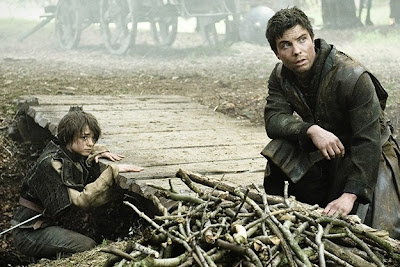


Yoren, the man escorting the group to the Night’s Watch, is also a great character, threatening the King’s Watch with a sharpened dagger that he says could “shave a spider’s arse” if he wanted to. Yoren, audiences might recall, is the last person Ned Stark called out to before he lost his head, shouting, “Baelor!” at him to indicate Arya sitting atop the Baelor statue. Yoren, who was a close friend of Ned’s, made his way quickly through the crowd and snatched Arya and covered her eyes, sparing her the soul-scarring image of her father being beheaded.

Something I keep thinking while watching this season is that for us, Ned Stark’s death happened ages ago, but for these characters it was quite recent; probably just a number of days. Arya is still reeling with shock, as is Sansa, and what we’re seeing is more immediate grief than it may seem to those of us who have been waiting almost a year to catch up with them again.

Christopher: H Boobs O, heh. Too true much of the time (not that I’m complaining). I’ve been teaching a grad course on HBO this term (you can have a look at our course conference here), and one of the frequent observations my students have returned to is how frequently the full frontal tendencies of HBO can be either discomfiting or decidedly unsexy (or both) as often as they can be titillating (the violence-tinged sex on Oz, for example, or the overly-modified strippers often in the background of The Sopranos). But GoT does seem to like to err on the side of titillation … even as it does on occasion combine elements, as we saw in Theon’s shipboard sex scene, which was an excellent bit of exposition on that character’s particular sense of self.

Speaking of … Theon was kind of a nonentity in season one (unlike his presence in the novel), so it was lovely to see him finally get a bit of traction—especially considering it meant he totally got humiliated, the self-important little git. What did you think of this new foray out to a previously-unseen part of Westeros? (That’s one of the things I love about the credits—readers of the books get a really nice little heads-up when the series is about to take us somewhere we’re familiar with in print, while non-readers get a nice little frisson of expectation). As already mentioned, Patrick Malahide’s performance as Balon Greyjoy is about as perfect a portrayal as we’ve yet seen. Theon’s sister Yara (Asha in the novels—why the name change, I wonder?) isn’t anything like how I pictured her, but I’ll withhold judgment until I’ve seen more of her. I thought she did a workmanlike job, but she doesn’t yet have the gravitas of the character in the novel … unlike Malahide’s Balon, who has more, if possible.


The theme so far this season seems to be an extended consideration of what makes a king. Theon shares Stannis’ belief in the absolute right of patrilineal succession, and is horrified when his father favors his daughter over him. By right of being eldest and only son, he thinks the crown is his (even though it doesn’t yet exist), whereas Balon privileges deeds. Yara has spent her time fighting and sailing while Theon learned how to ride and wear nice clothes and jewelry purchased with gold, ergo has more right to Balon’s seat. This debate is interestingly paralleled in the theological discussion between Davos and Sallador and Davos’ son. Both the smuggler and the pirate have a much more pragmatic approach to whom they owe their devotion, while the son’s devotion to the God of Light reflects a belief in transcendent principles like divine right.

Whereas Cersei’s devotion is entirely to power, and is petulant and prickly whenever Tyrion suggests that there might be strategic value in being nice to common people. And we already see the effects of that attitude—and will see it get worse as the season goes on.

But of course, the most crucial question of this episode: again, Tyrion announces his presence by whistling somewhat ominously offstage. Does this mean he’s GoT’s Omar? Or is it an ironic allusion to the seven dwarfs?

Nikki: Seven dwarfs, I never thought of that! Last week I suggested it was an allusion to Omar, and when he whistled his eerie whistle again, I was thrilled. Oh, Tyrion. Once again he is the bane of Cersei’s existence. From telling her she’s perfected the art of ripping up papers to confronting her (passive aggressively) about Jaime, once again he knows how to cut her down. But Cersei has had enough, as is evident near the end, when she finally fights back:

Cersei: It’s all fallen on me.
Tyrion: As has Jaime, repeatedly, according to Stannis Baratheon.
Cersei: You’re funny. You’ve always been funny. But none of your jokes will never match the first one, will they? [OUCH.]… Mother gone, for the sake of you. There’s no bigger joke in the world than that.

Tyrion, for once, is silenced. Last week he looked at her and asked what it was like to be the disappointing one, finally throwing the burden of having been exactly that on her shoulders. But here she throws it right back at him, and he has nothing to say in response. Tyrion uses words as his weapons, and also as his armour. But as we see here, they can hurt him right back, if the proper ones are chosen.
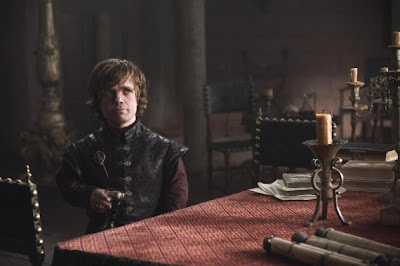


Tyrion also goes toe-to-toe with Varys, who is one of the best players of the game. Ned Stark asked him last season which side he was on, and he simply replied that he was on the side of the realm. That guy is cool as a cucumber, and acts like he has nothing to lose, but he’s so cunning he can even make Tyrion nervous. (By the way, I just wanted to note that the “fish pie” exchange was positively Shakespearean. It was like something between Aguecheek and Toby Belch in Twelfth Night.)

And the best Tyrion scene is the one with Janos, commander of the City Watch. Tyrion opens by addressing him as Lord, and Janos is arrogant enough to think he’s on par with a Lannister. (Or, more likely, that he’s above him.) Tyrion is trying to get to the bottom of who ordered the slaughter of babies, and mentions that Janos had killed the last Hand of the King, Janos responds, flustered, “He tried to buy my loyalty!”

Tyrion: The fool. He had no idea you were already bought.
Janos: Are you drunk? I will not have my honour questioned by an imp!
Tyrion: I’m not questioning your honour, Lord Janos. I’m denying its existence.

Ha!! And then Tyrion shows him who really has the power. (For now.)

As for Theon Greyjoy, I’m very surprised they changed the name! Do you think the writers worried that Asha was too close to Arya, and silly TV viewers wouldn’t be able to keep them straight? It’s very strange they would randomly change a name. But yes, that took me by surprise, that she was actually his sister — I loved the look on Theon’s face as he realized it himself, and threw up in his mouth a little (the obvious or implied incest on this show is extraordinary… I should just start assuming every love interest is a brother or sister…)
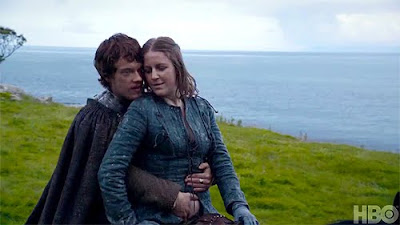


Last season I remember some TV critics suggesting that George RR Martin was a chauvinist, since the women all seemed to be subservient to the men or pushed into corners, but I find it quite the opposite. Catelyn is an equal to her son Robb, and Ned turned to her for advice. Daenerys is the Dragon, not her stupid brother, and the Khaleesi, despite slowly starving to death right now, will rally back to take care of her people, I just know it. Arya is one of the best characters on the show, and despite Gendry seeing through her exterior, she has tricked most of the men around her into believing she’s a boy because of her outward toughness and self-confidence.

Balon Greyjoy is an excellent character. Am I right in recalling that he went to war with Ned Stark, and Ned took Theon from him as some sort of hostage to keep Balon in line and raised him as a ward? And here’s my question: If Balon was the king of the Iron Islands, was the Iron Throne his? Is that another thing Ned took from him? (That giant squid sculpture above the fireplace was amazing, by the way.)

But back to what I was saying, his argument that Yara deserves high status, gender be damned, was an interesting one, and despite him being the enemy of the Starks, I found him intriguing in his loyalty to her. Though on the other hand, despite the fact I’m not a huge fan of the philandering Theon, I felt bad for him when he didn’t quite get the homecoming he was looking for from Daddy.

Just as Balon is arguing that women should be treated as men’s equals, Crastor and his daughter-wives (speaking of throwing up in one’s mouth a little) represent the opposite. As the boys from the Wall discuss previous sexual exploits, one with a milkmaid named Violet — “I wish I grew up on a farm,” says Sam wistfully — they give in to the typical locker room talk, but Sam still believes that women should be shown respect. Jon warns him about trying to help out one of the daughter-wives, saying she belongs to Crastor, and Sam counters, “She’s a person, not a goat.”

I’ll let you have the final word this week, Chris, but here are some of my questions. Some of the answers may be spoilery, so just avoid those:

In the group of people going to the Wall, there are three men locked in a cage. The one man seems to be someone who will become more important (it sounded like they called him Jackenheier, but I’m 100% sure that I did not spell that right). You don’t have to say whether or not he becomes important, but did you think he was well cast, whoever he is?

I loved the look of the scene between the priestess and Stannis – especially the symbolism of the armies falling off the map as they consummate their relationship. I know you talked about her last week, but could you just jog my memory: how did they meet? How did she become someone who follows Stannis’s group? Are we supposed to know these things yet or does that material come later? I still find that part a little bit hard to follow.

The scene with Davos and the pirate was great, especially him demanding Cersei in return for helping them out. Davos seems like a very smart man, whereas Stannis almost seems unhinged, more someone who could be manipulated than someone who is a born leader. Davos, however, seems intensely loyal to him. It seems Stannis helped him and his son at one time in the past. Is Davos aware that Stannis is falling apart?

And I agree with you; the opening part showing where all of the new places are is very helpful (though I fear that by season 5 the opening sequence will be 10 minutes long! Haha…)

Back to you, Chris, for the final word!

Christopher: The Balon Greyjoy backstory is that eight years before we begin, he rejected the authority of the Iron Throne and crowned himself. Ned Stark was Robert Baratheon’s right hand man when they attacked Pyke, and yes, Theon was taken as a hostage after that. And the Iron Islands and the Iron Throne are just serendipitously named … though we didn’t see it in this episode, the traditional seat of power in the Iron Islands is the Driftwood Throne.

As it happens, I had it from a student just an hour ago that the reason they changed Asha to Yara was indeed because they were worried about people confusing the names with another character—but Osha, the wildling woman (aka Nymphadora Tonks), not Arya.

The man in the cage you’re asking about is Jaqen H'ghar, and I won’t say anything about him other than, yes, he does seem pretty well cast. I’ll have to wait and see to be sure—in the book, he comes to play a fairly crucial role—but for the moment he seems good.

To offer the novels’ backstory about Melisandre, she came to join Stannis because she believes him to be a man of destiny, the one who will fight against the forces of cold and darkness … hence her devotion to him, as well as her manipulation of him.

I don’t want to say too much about Davos, as I don’t know yet how much the show will choose to reveal about his back story; but so far, he’s true to the books—and yes, he worries about Stannis, but is so absolutely loyal to him that he will basically follow him anywhere.


So that’s that for this week … I swear, this season just keeps getting better. Perhaps as the one of us who’s read the books, it shouldn’t surprise me that season one now kind of feels like the set-up for season two, that all we watched last year was essentially prologue. Because now the fun really begins …

Nikki: Thanks, Chris! Looking forward to next week’s episode, just to find out what the hell that thing was in the woods that took the baby (is that a white walker??) And also, looking forward to Daenerys’s story becoming more interesting, though I did like the way she calmed the grief-stricken woman in this episode, showing she rules with a kind heart, even if that heart is filled with vengeance.

Until next week!

Pulp Reunion!

Pulp played "Common People" on Jimmy Fallon last night, and you could probably hear my squees around the block. Sadly, despite attempting to get tickets to see them at Radio City Music Hall, my husband and I failed. But I'll take this for now. ;) (I recommend clicking the fullscreen button just for the complete effect!)

Wednesday, April 04, 2012

Game of Thrones S2: The North Remembers


And here we are, ready for a second season of Game of Thrones, with my co-host, Christopher Lockett, who will be reviewing the episodes from the point of view of a reader of the books (I’ll just be looking at them as episodes, not adaptations).

Now first, I had mentioned that I was probably going to read book 1 after season 1 was finished. Chris was worried, saying that if I did that, I probably wouldn’t be able to stop. But what I found was, as I was reading them I was gaining perspective into Martin’s characterization, and how that differed from the way the characters are portrayed on the show, and, worried that it might affect the repartee between me and Chris (Bran is 7? Jon Snow is 14?? Daenarys is 13??!!) I decided to stop reading, and leave them until the end. Or, after season 2, if I simply can’t resist any longer. ;)

So, quick catch-up on season 1: King Robert is dead, Ned Stark was beheaded, Cersei likes doin’ it with her twin brother Jaime, their son Joffrey has taken over as a sociopathic boy king, Sansa Stark is betrothed to him but hates him because he just killed her father, Arya has escaped town dressed as a little boy, Daenerys married Khal Drogo, he killed her evil brother Viserys, he then died, and she brought forth freakin’ dragons by entering the fire with them and hatching their eggs.

And if you didn’t follow any of that, you probably didn’t watch season 1, so go back and do that now. And in the meantime, Chris and I shall review this week’s season 2 premiere episode:

Nikki: Game of Thrones is back with a brilliant return that hasn’t lost one iota of its action, character-building, sharp dialogue, and set design. What a glorious show this is.

So I’ll start with my favourite thing about this return, and what a lot of people were anticipating… Tyrion. He makes his grand entrance right near the beginning, walking in on Joffrey’s sadistic name-day ceremony, dropping a few verbal bombs just to piss off his insane nephew, and then marching into the Small Council, where he pisses off his sister even more by announcing he’s the new Hand of the King. When he first walks in he makes a big show of insincerely greeting all of his nieces and nephews, and then pauses and genuinely offers his condolences to Sansa, infuriating Joffrey. Sansa looks at him, pledges her undying love to Joffrey, and flatly calls her father a traitor. You can’t trick a trickster, and there’s a slight shift in Tyrion’s face that signals he gets it: Sansa is a very smart girl, and she’s playing the game just like everyone else is. She’s saying what she needs to say to stay alive, and is burying her emotions so deep the only concern is she’ll forget what they once were.


But Sansa’s not the only one who feels helpless, and must use her wits to stay alive. Tyrion is much the same as she is, and when he drops the bomb that he’s the new hand of the king, his sister goes mental. First, did you notice he signals his arrival with a creepy whistle now? You can hear him before you can see him. As soon as I heard this, I thought, “He’s Omar!!” that other fan favourite from an HBO series.

The biting words between the two of them are one of the highlights of this episode:

Cersei: What do you know about warfare?
Tyrion: Nothing. But I know people, and our enemies hate each other almost as much as they hate us.

Tyrion: You love your children. It’s your one redeeming quality. That and your cheekbones.

Tyrion: We had three Starks to trade — you chopped one’s head off and lost another. Father would be furious. Must be hard, being the disappointing one.


The smug look on Tyrion’s face at this last one, and Cersei’s sudden shocked silence, speaks volumes. What a turnaround this moment is. Cersei should have all the power now, with her son sitting as king, but she’s nearly as smart as Tyrion, and is ruled by her emotions for Jaime. I absolutely adored this scene.

Chris, one thing I kept wondering while watching this early episode was this: Tyrion was clearly a fan favourite in season 1, and Peter Dinklage was the one who garnered all the attention come awards season for his performance (which is brilliant, even though I must admit my nitpick again that I think his accent could be better; it’s nothing like the others and doesn’t sound right). This season he’s suddenly the major character. Is that because of the books? Was he a fan favourite in book 1 and so George Martin brought him front and centre in book 2? Or is this a television-led thing? Or, was Martin always intending to bring him forward from the beginning?

What were your general thoughts about this first episode?

Christopher: Without giving anything away, I think it’s fair to say that Tyrion takes over Ned Stark’s role as putative protagonist in book two, but then that’s also a hard case to make as Westeros gets Balkanized and our story fragments into even more disparate narrative threads. Tyrion does play a more central role than he does in book one; which was why, in addition to squeezing over Dinklage’s wonderful interpretation of Tyrion (accent notwithstanding, and yes, I agree with you on that front), diehard GRRM fans also breathed a sigh of relief—it would have been a painful thing for such a pivotal character to have been poorly cast. Fortunately, that is not an issue.

As for GRRM increasing Tyrion’s role after book one: unlikely. To hear the man himself speak of it, the Ice and Fire series took a few books to get going. I suspect that he either had planned Tyrion’s prominence from the start or realized that this snarky dwarf was the best thing in Westeros early on.

So … my thoughts on this episode. I can honestly say I have no complaints, and am deeply impressed both by what they’ve been utterly faithful with, and what they’ve added. I’ll first add a disclaimer that I haven’t had a chance to reread A Clash of Kings prior to April first, as this is my busiest time of year, but I’ll be getting on that this week. So if I lose a detail here or there, I apologize.

I’ll start with my first genuine squee moment, which happened during the credits. Dragonstone! The island fortress guarding the approaches to King’s Landing plays a much more significant role in the novels than it has in the series so far, and not just because we haven’t seen it until now: it was where the first Targaryen king planned his conquest of Westeros, and it was where Daenerys was born while her mother and brother fled the armies of Robert Baratheon. And it was the seat King Robert granted his brother Stannis, which always rankled with the dour martinet, as it meant the youngest brother Renly (who wasn’t old enough to fight in the war) got the ancestral Baratheon seat of Storm’s End.


In book one, both Stannis and Dragonstone are spectral presences, spoken of but never seen. So one of the great pleasures of A Clash of Kings was finally meeting Stannis there. And I certainly wasn’t disappointed by the way that fell out in our opening episode: what we see of Dragonstone is appropriately grim and dark, and Stannis himself is likely appropriately dour and humourless. Casting Stephen Dillane in the role shows that series continues with its deft casting choices. I loved the scene in which he drafts the letter revealing Jaime and Cersei’s incest and making his claim to the throne. On occasion, the series has been a bit clunky in its exposition. In this case, it was beautifully done, and utterly faithful to the text. His refusal to countenance even a lie of courtesy in calling Renly “beloved”; his insistence that Jaime be labeled “Kingslayer,” because that is what he is; but also insisting on the honorific “Sir” because, “whatever else he is, he is still a knight”; this short sequence tells us everything we need to know about Stannis’ character, and Dillane’s severe, harsh delivery is pitch-perfect.

Other new faces! We meet Melissandre, Stannis’ red priestess who has seduced him (not literally) into renouncing the seven gods of Westeros, and his devoted and trusted right-hand-man Davos Seaworth. I won’t say anything more about these two for fear of spoilers … suffice it to say, they are also pretty much exactly as I imagined them.

So far, the new season seems to be preoccupied with the question of how to rule—with what makes a king, or queen, or simply a leader. We shift thousands of miles between scenes, with the ominous comet as our segue and reminder that, however distant, all of these stories are intertwined … and fated to meet. Nikki, what did you think about the way the episode dealt with all of the different threads left over from season one?


Nikki: Funny you should ask that, because the first time I watched this episode that’s exactly the point I brought up with my husband: that “The North Remembers” is the perfect blend of wrapping up the previous season while opening up the new threads that will be carried through this season. Bran, left behind in Winterfell, is now a lord, having to listen to the complaints of villagers. But he’s having different visions (remember he had those strange dreams in season one) that, this time around, appear to be aligning him with his direwolf. Is he somehow sharing the soul of his direwolf in a way? Robb, “King of the North,” is maturing as a leader, working alongside his mother to try to broker peace, but on his terms. Daenerys is in The Red Waste, and her baby dragons are with her. I know a lot of us were dying to see those dragons, and they really looked amazing. I thought there was a bit of incongruity with the special effects, as in Emilia Clarke wasn’t looking right at the dragon, but more in front of her, as if her eyes weren’t aligning with the dragon properly (which obviously wasn’t on her shoulder). However, when she reached up and let it move to her hand and put it in the cage, the effects were amazing, and she moved her arm as if there really was a dragon on it. I LOVE them so far, and hope we see more of them. Jon Snow is with the people from the Wall at that vile man’s house (his daughters become his wives to make more daughters… Jee-SUS), Joffrey is showing how absolute power corrupts absolutely, and Sansa is reeling from what is probably post-traumatic stress disorder and covering up her hatred to save her own skin. And Arya, that character we fell in love with in season 1, only shows up in the closing seconds of the episode, looking every bit a boy on her way to the Wall.

But for season 2, there are the new people at Dragonstone, as you pointed out, and the Fire Priestess and Stannis, and his brother Renly. We only heard about the other Baratheons last season, so it’s good to actually see them now. I was thrilled with your rundown of them, because I did find these scenes a little confusing, not being familiar with the characters. I will certainly be turning to you week after week to explain things to me! Does the Fire Priestess worship dragons at all? Why is she at Dragonstone? Is there a connection between her and the Targaryens? Is it too soon for me to be asking all these questions? ;) The priestess is creepy as hell, but gorgeous with those chiseled features, and her words ring through the episode. “The night is dark and full of terrors… but the fire burns them all away.”

Christopher: We met Renly last season, remember? He sat on the Small Council with Ned, tried to convince him to usurp the Lannisters while he had the chance, and is closeted gay (remember the bath scene with Loras Tyrell). Renly’s sexuality is only ever hinted at in the novels, so it will be interesting to see how they play it on the show when we meet his betrothed, presumably in the next episode when Catelyn journeys to meet with him.

I’m not sure how much to say about Melisandre, the fire priestess, as I don’t know how much the show will choose to reveal, and whether or not they’ll hew to GRRM’s specifics. But this much is safe: she worships the god R’hllor, the god of heat and light and life. Her belief system is Manichaean, positing R’hllor on one hand, and the god whose name must not be spoken on the other, Voldemort. No, wait … I kid. R’hllor’s foe is the god of anti-life, of darkness and cold.

Sort of like what might, I dunno, be lurking in the “real” north? Heh.

Speaking of the real north … that scene in Craster’s Keep was (pardon the pun) chilling, no? I wondered how they were going to treat that particularly revolting character. I must say I always imagined him bigger; he’s described in the novels as a huge man grown egregiously fat, but still powerful. (Actually, whenever I read his parts, I always find myself thinking of Judge Holden from Blood Meridian). But they captured his particular mix of petulance and pride, and the smugly proprietal way he treats his “wives”.

And remember the pregnant question (sorry, couldn’t help myself) “What does he do with his sons?” That one will be something we return to.

And to return to what I guess we now have to consider the fake north—what did you think of Robb Stark’s confrontation with Jaime Lannister? That was not in the novel, but was, I thought, very well done and did a good job of laying out just how dangerous a prize the Kingslayer is. And: holy direwolf! They do get big, don’t they?


Nikki: Oops, sorry, in my haste I meant to say seeing Renly being incorporated more directly into the Baratheon battle was new. Yes, I absolutely remember him in the first season (my first comment to my husband was, “Isn’t that the gay king?”) and yes, we will see his significant other(s) in next week’s episode.

I thought Robb Stark’s confrontation with Jaime Lannister was brilliant, and it brought up something I wanted to talk about in this last segment: that this episode was all about power. Who has it, who is willing to use it, and what power actually is. The best ways they demonstrate that is by showing the two very different mother/son relationships on the show.

Tyrion, as I mentioned earlier, has the power of words. He knows just what to say or do to make people listen, or piss them right off. Since he doesn’t have any physical or political power, he makes do with what he has, and is able to take people like Cersei and make her wither in his presence.

Robb Stark faces off with Jaime, who mocks him for being a boy. Even tied up, filthy, sitting on the ground, Jaime believes by being a Lannister, he will always be more powerful than Robb. Robb, however, sees it differently, spitting back, “You’ve been defeated by a boy, held captive by a boy, perhaps you’ll be killed by a boy.” Jaime is unfazed. “Three victories don’t make you a conqueror,” he says.

“It’s better than three defeats,” says Robb smugly. And then he lets his direwolf step into the cage to sniff Jaime. Who promptly pees his pants (offscreen).

Robb is stronger than he seemed in season 1. When he discusses his position with his mother, Catelyn, you can tell the two of them see their role in the war as a partnership, working together. He sends her off to Renly, and has everything in hand, and she agrees to go, telling him he’s doing a great job. She looks upon him with the same pride she looked upon her son.


Cersei, on the other hand, doesn’t have that relationship with her son. After being shown up by Tyrion, she decides to bring someone else down to make herself feel better. She confronts Baelish and asks him what power is. He replies, “Knowledge is power.” Which is what Tyrion would argue. Then she uses her guards as little toy soldiers, instructing them to slit his throat, then stop, then walk three paces away, turn around, close their eyes… and do the hokey pokey. They do it all, and she looks at Baelish with a sneer, saying, “Power is power.”

Is it? Those guards only do what she wants because Joffrey has told them to respect and obey his mother. But the moment he says otherwise, she will be nothing but a speck of dust to them. And if the Lannisters are overthrown, Joffrey has no power, either.

After this moment of triumph, Cersei speaks with her despicable rat-son Joffrey, who throws the possible incestuous relationship with “Uncle Jaime” in her face, and she slaps him across his. He stares at her and says, “What you just did is punishable by death. You will never do it again. Never.” And suddenly Cersei realizes she has very little power indeed. She can make her guards put their left foot in and take their left foot out before shaking it all about, but he can tell his guards to go all King Herod on the place, killing every bastard child who has dark hair. For now, that is power. But how long will that last?

Next week: King Joffrey falls into a vat of hot, burning oil, and then… no? That doesn’t happen? Rats.

Sunday, April 01, 2012

The Hunger Games: The Movie

[Warning: Spoilers ahead for both the Hunger Games movie and book. Please don’t continue if you haven’t read and watched it, and read with caution if you’ve only read the book and haven’t yet seen the movie.]

My family just got back from a week in the Dominican. When my husband booked the trip, he announced at dinner that he booked it for March 23. My brow furrowed, and I said, “Something is happening on March 23.” He looked at me, stunned… this is the guy who NEVER looks at a calendar before booking things, and is constantly double-booking everything he does. (Half my DVD collection is probably “I’m sorry” gifts from when he’s booked golf travel pieces – he’s a golf writer – on special occasions. Other women want roses or jewelry; he knows the way to my heart is a DVD box set. Ha!)

“No, nothing’s on the 23rd!” he cried. “I actually CHECKED for once.”

“It’s weird… it just feels to me like something is on that date.” I kept eating... could it be that I just constantly have Hurley's numbers in my head, and any mention of 23 has me saying, "Why, that date is IMPORTANT!" About five minutes later sat back in my chair. “Ah! It’s the opening of The Hunger Games!!!!” He stopped, fork midway to his mouth, closed his mouth, tilted his head, and said, “Really? Really, you save that information in your head?”

“Look, you save every baseball stat in your head since the early 1930s. Let me save important release dates for films and TV shows in mine.”

Ahem.

So, as our plane rose into the air, I knew that everyone at my work was heading to the film that night (having bought tickets in advance) and I’d be missing it. Ah well, maybe we’ll figure out a way to get babysitting the weekend we return, and we’ll get to see it. And we did.

So, off we went to see the movie yesterday. I originally discovered The Hunger Games when a friend of mine mentioned her teenage son was reading the books. The second book had just come out, and she said to me, “Have you heard of this?” No, I hadn’t. “You should read them; they’re fantastic. My son has read them several times.” So I did. And then, unlike the majority of adult readers of the series, had to WAIT for Mockingjay to come out because I’d started reading just as the second one was released. I loved the first book, and thought the second book was even better. (The clock set? Brilliant.) The third book was a bit of a letdown, but the epilogue was great, and really brought things around, for me.

My husband, despite calling me the family geek, has a sci-fi streak in him as well, and I told him these weren’t Y/A novels like Twilight; in fact, I’m surprised so many really young kids are reading them. (Just my opinion – every parent is entitled to their own decision based on the maturity of their kids – but I think I’d recommend them to my daughter when she’s about 12 or 13, but not younger than that. But she’s an extremely sensitive girl who cries if she finds a dead butterfly on the ground, so these books are probably a little harrowing for her.) By the way, I could write an entire blog post about this, but while the jury may be out on whether 10 is too young, I don't think many people would think 4 is the proper age, yet the theatre we went to was FULL of children who should have been seeing the Lorax (I saw as young as 18 months, a few around 3 and 4, and lots of ages 5-8), and I thought that was awful. Right. I'm sure your kid in grade 2 will totally get all of the subtle political satire. And won't have any scary nightmares about Rue yanking that spear out of her chest.

Anyway, I talked my husband into reading the first one, which he did in one afternoon (damn him for his fast reading! What I’d give…) And then he devoured the next two. He loved all three of them, and the third one more than I did, I think.

And so, despite his snarkiness, he was pumped to see this movie as much as I was. Kids were off at playdates, and we went to the movie. And then, as we left, he said, “So? What did you think?” And for the first time, I had to pause a long time before I could come up with a proper – and qualified – response. As a movie on its own – not as an adaptation – I thought it was interesting. If I hadn’t read the books, I think I’d definitely have a sense of the political turmoil that surrounds the Hunger Games, I’d know the lead-up, I’d have a sense of who Katniss was, and I would know at the end of the film that there was definitely a second one coming.

But, as someone who’d read the book – and this could actually be a testament to Suzanne Collins’ ability to describe everything to a T – there were times where I found myself a little bored. Bored because I knew what was happening next; very little was surprising or changed from the book (but there were subtle differences). Now, I wasn’t bored the whole time, obviously, and by the end of the movie I realized there are ways the movie functions on its own that are more effective than the book. I’ll get to that in a minute. The sets were stunning, and it was like the set designer reached right into my head and pulled out EXACTLY how I’d pictured things – well, most things – and put them right up on that screen. But that could have been part of the reason I felt it lagged a bit at parts.

What I loved:
• I know there were a lot of haters, but I was thrilled with the casting of Jennifer Lawrence when I heard about it (having been a huge fan of her work in Winter’s Bone… and seriously, does that woman have to cook and eat a squirrel in every movie she’s in?) and my conviction was rewarded in this. I thought she was a fabulous Katniss.
• The Reaping. Even though I knew exactly what was going to happen, I felt my hands start to sweat and imagined myself as every child standing there, not breathing, waiting for his or her name to be called. That scene was absolutely terrifying (and Elizabeth Banks was wonderful in her constantly clueless, perky, annoying way).
• Rue. She was exactly as I pictured, from her eyes to her tiny stature, to her sweet, mousy little ways. The scene of her covered in the flowers was lovely and heartbreaking. (I read an article recently that talked about how fans were upset with the casting of Rue and Cinna, because neither one of them was black in the book, and I was shocked. People really need to learn how to READ and not skim their books, because both of them were clearly described as having darker features. Rue was perfectly cast.)
• Speaking of Cinna, my husband thought Lenny Kravitz was miscast, because he thought Cinna was much younger and more effeminate, but I kind of liked him. I thought he looked much younger than his 50 years, and he played Cinna as someone whose sexuality was unclear, but unlike the Cinna of the book, who gave in to the flamboyant looks of the Capitol, this Cinna is more rebellious, preferring to dress in only blacks and have a bit of eyeshadow on his lids.
• The set, as I mentioned. From the clearing to the trees and water, I thought it was perfect.
• The Capitol, and the crazy fashions and styles of the people living in it. Again, from the bright colours to the insane styles and doll-like makeup and dandyesque quality to everything, it was almost exactly as Collins had described it.
• The outfits on fire. I had no idea how they were going to execute it, and I thought it was WONDERFUL.

A lot of the book was left out, obviously. Where Collins spent pages describing the fashions of the people in the Capitol, a simple sweep of the audience in the movie covered that off, so they gained ground there. But you don’t see a lot of District 12, or get a sense of how important Katniss and Gale are to the rest of the town. Speaking of Gale, he’s a very minor character in the film, with only a handful of lines and appearances.

I remember the sadness of Katniss lying strapped to her tree and watching the skies each night for the In Memoriam of each person who’d died that day, but I’m thinking they just showed it once to let you know it happened, and didn’t harp on it repeatedly. I really did love the music they used for that the first time, and the tunes that both Rue and Katniss whistled for the mockingjays.

Now, I’ll admit, I’ve read the book only once, and that was two or three years ago, but I remember the mockingjays playing a much bigger role. I believe you could talk around them and they’d mimic what you said, and you could hear what other people said, not just sang (am I remembering that correctly?) {UPDATE: Dusk just pointed out in the comments that I'm mixing up the mockingjays with the jabberjays. Thanks, Dusk!!} Also, I pictured the tracker-jackers being bigger and more mechanical-looking (my husband thought exactly the same thing) and these just looked like bees. And partway through the film, I suddenly realized, “They’re not going to do the hybrid dogs. If they do the wild dogs at all, they’re not going to have the faces of the fallen.” Sure enough, they were just wild dogs. Having the faces of Rue and Foxface in the book was far, far creepier.

And other parts of the movie were entirely new. I barely remember the game-maker in the book; I’m sure he’s there and he just didn’t stick out in my mind, but Wes Bentley has a much bigger role than I remember that guy having in the book. (And I couldn’t take my eyes off his curlicue beard; that was fantastic – I was delighted to see Bentley in a major role again, by the way; I think he's a very underrated actor.) In the second book (SPOILER) the arena is manipulated more obviously by the game-makers. But in the first book I don’t remember them doing too much to the actual place; where Wes’s character says, “Make a tree fall” and someone sweeps their hand to do it, I don’t remember that happening in the book at all. Perhaps I’m either not remembering properly, or Collins created a more controlled environment in book 2 and wished she’d done it in book 1, so this screenplay allowed her to do that. But watching this woman create the wild dogs on the computer, then raise them with a flick of her hand and send them on out to the playing board, was cool to watch, even if it didn’t feel true to the book. It was something new that captured my attention.

But here’s the thing: Watching the movie was an entirely different experience than reading the book. While the plot itself was the same – hence the moments where it almost seemed to lag, whereas the book never stopped for an instant – the experience was different. Here’s what I mean: When I read The Hunger Games, I was reading this politically charged satire of a world gone wrong, a world controlled by a heavily top-down government that is so awful the only way it gives the people hope is by massacring their children. But when I was watching the movie, I suddenly had a terrible feeling wash over me partway through: I just paid money to watch children massacre each other. I am complicit. I am one of those people watching the 74th Annual Hunger Games on the screen.

As a result, I felt uneasy for the second half of the movie, which takes place in the arena. The book was heavily detailed, where every battle lasted several pages and every facet of every death was described, and it only occurred to me after I’d finished the series that there were parts of the books where you’re rooting for Katniss (obviously) over other children… but they were children. We shouldn’t be rooting for anyone, which was what Collins was trying to tell us. But when the books tell us the perspective of the characters and get into their heads and make them come off like little adults, you sometimes lose perspective that even if they were trained in some military from infancy and volunteered, that doesn’t make them heinous; they’re still being thrown to the slaughter, regardless of how well trained they are.

But the movie brought all of this home. When the little boy with the big curly hair is lying motionless at the Cornucopia at the very beginning, I imagined myself being his mother and watching that on the screen. As Rue giggled and conspired with Katniss, I realized she was about the same size as my daughter, and I saw my daughter’s laugh and eyes in her. As Katniss sat over her, singing her to her death, again I imagined Rue’s mother watching with horror that her daughter had just died, but having some relief that she didn’t die alone, that Katniss had been there.

So ultimately, I think both the movie and the book work extremely well, but for different reasons. The books explain the background much better, and give you a sense of the despicable politics and world that could allow something like this to happen. They instill in the reader the anger that Katniss has within her to keep her going, and you want to see her show up the Capitol, and cheer when she and Peeta manage to do it at the end.

But the movie brings home the reality of the Hunger Games. These are children killing other children, and it’s wrong on many, many levels, in a way that really hits home and makes you angry through your tears. The Hunger Games are not about hope, despite the bullshit that President Snow spouts. They are entirely about control and a reminder of what the Capitol could do to you should you step out of line. As you watch that movie, you become a mother to every child that falls, even Cato, who at the last moment stands with his hands about to break Peeta’s neck, crying that he knew he was dead the whole time.

My immediate reaction upon finishing the movie was that I’d recommend the books to people over the movie. But upon reflection, I think it’s worth going to see the movie in addition to the book just to get a slightly different perspective in the movie. When you read it, you’re above the situation, shaking your head in disgust at this culture. But when you watch the movie, you become complicit, paying for your ticket and watching children kill each other, thankful that it’s not happening to you. In that sense, this is one of the most fascinating and unexpected adaptations I’ve seen.

I’d be interested to hear from people who saw the movie but didn’t read the books first. Everyone I know who went had also read the books, but if you didn’t and saw the movie, please leave a comment and tell me what you think. And for everyone else, I’d love to hear what you thought of the movie as an adaptation, and whether your experience of watching the movie rather than reading the book was similar to mine or completely different.