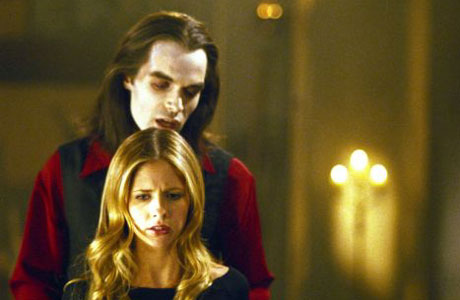
5.7 Fool for Love
5.8 Shadow
5.9 Listening to Fear
And if you’re watching Angel, this week’s eps are:
2.7 Darla
2.8 The Shroud of Rahmon
2.9 The Trial
As I mentioned last week, “Darla” is a parallel episode to “Fool for Love,” where instead of Spike’s backstory we learn a lot more about Darla; the two overlap in the scene with Spike arguing with Angel in Yorkshire, and during the Boxer Rebellion. “The Shroud of Rahmon” is a bit of a throwaway episode, but “The Trial” is frakkin’ brilliant. I hope some of you are trying that other Joss Whedon show!
But in the meantime, let’s get back to Buffy and “Fool for Love,” one of my all-time favourite episodes, and as I also mentioned last week, in my top three episodes of season 5 (alongside “The Body” and “The Gift”). For now we finally see Spike’s backstory, something that was as anticipated among BtVS fans as Ben Linus’s backstory was to Losties. And wow, did it deliver. James Marsters puts in a fantastic performance as William, the bloody awful poet with a penchant for ridiculous rhyming words… and Cecily. We see that Drusilla was actually his sire, not Angel, as stated back in “School Hard,” (prompting Joss Whedon to explain that Angel sired Drusilla, and Dru sired Spike, therefore that makes Angel his sire… no, hon, that makes him his grandsire, but we’ll forgive you the inconsistency), and we see how quickly he devolves from a lovesick puppy into Spike. The thing is, it puts into perspective his feelings for Buffy… because at his heart, Spike will always be a bit of a lovesick puppy. His bravado is mostly an act – where Xander believes he’s the team’s butt monkey, it’s Spike who is the butt monkey of the writers, always making some grandiose speech before tripping or falling into a grave or getting zapped… He feels so deeply, and as we learned back in “Doppelgangland,” a vampire actually has personality traits from their original host, and Spike shows his stripes far more strongly than the others do. Spike isn’t that far removed from William.
And the parallel between the two of them is made obvious when, at the very end, Spike is crushed by Buffy the same way Cecily destroyed him 120 years earlier. With a flick of her hand and a “You’re beneath me,” she leaves him lying in the street, crushed… and crying, just like William had done years earlier. But Spike has learned something about life in the last century, and where William lumbered off to find peace in the arms of a monster, Spike decides to find his revenge on Buffy and to kill her once and for all. But no matter how tough he pretends to be, the lovesick puppy comes right back the moment he finds her lost and crying in the backyard. Spike sitting beside Buffy, awkwardly patting her back while she cries, is one of my favourite moments of the series.
Well, that and punk Spike on the NY subway. Awesomesauce. (And I can’t remember if this is revealed in this episode or later, but the Slayer that he killed was named Nikki. But of course a rockin’ chick from the 70s named Nikki is the source of his amazing leather duster…)
Buffy is crying because she’s received more bad news about Joyce. This week’s triptych of episodes focuses a lot on Joyce’s condition and where it’s coming from, while introducing Glory, the crazily powerful chick in the red lipstick? Who’s Glory? Keep watching….
“Shadow” is a brilliant episode, because of the extreme highs (Glory and her minion) and extreme lows (Buffy listening to the doctor deliver the bad news).
I ADORE Dreg, Glory’s minion. Or should I say… Marshall Flinkman. ;) Even through the makeup and face prosthetic, Kevin Weisman’s brilliance shines (c’mon, Alias fans, hands up!). His overelaborate adjectives are some of my favourite things this season: “Most beauteous and supremely magnificent one…” “most tingly and wonderful Glorificus...” “Forgive me, shiny special one…” “your elaborate marvelousness…” “your terrifically smooth one…” “Your creamy coolness has honored me by speaking my name. Your voice is like a thousand sweet songbirds that…”
Spike adds more humour when we find him sniffing Buffy’s shirt, and Riley continues to feel helpless around Buffy, and is increasingly pushed out of her life. Spike to Riley: “Least I still got the attitude. What have you got, a piercing glance?” Poor Riley. I really, really feel terribly for him. I think despite everything, he’s such a good guy. He wants to be there for her, but no matter how much of a tough guy he is, she’s tougher. Riley Finn was such a useless character in S4 that he’s stuck being the hated Buffy character for life. It’s too bad, because as I’ve been saying from the beginning of S5, his character really changes this year, and Marc Blucas puts in a hell of a performance.
But the real pain in this episode happens with Joyce. “I’ve got a shadow.” Those four words have always struck dread in me… it’s such a scary moment, especially when Joyce’s voice catches and she says unconvincingly, “Just a shadow.” The directing and writing in this episode is brilliant when the doctor delivers the news to Buffy, and the world falls away as Buffy sits alone, the phrase “brain tumour” ringing in her ears. “One out of three people who get this turn out to be just fine.”
The shadow that’s found on Joyce’s CAT scan isn’t the only one in this episode, however, and when Buffy realizes that Dawn isn’t actually her sister, it creates the about-face in her attitude. Her sister is innocent, and Buffy protects the innocent.
“Listening to Fear” isn’t one of my favourite episodes (the snot monster from outer space always makes me think of Mini-Me as a caterpillar stuck in its cocoon…) but it deepens the mystery surrounding Joyce, shows how Buffy is suddenly having to be thrown into the position of mother to both Dawn and Joyce, and how her life has become so complicated it makes high school look like a walk in the park. Just as S5 is Marc Blucas’s season to shine, so too is it Kristine Sutherland’s, who plays Joyce. She’s amazing in this episode – and terrifying when you put yourself in the shoes of Buffy or Dawn – as she moves from vicious to whimpering in a moment.
This week I’m thrilled to bring back Rhonda Wilcox, aka the Mother of Buffy Studies, to discuss our three episodes and put them within one thematic context. Welcome back Rhonda!
“It’s Not About the Moves, Love”: Conversations in Body Language
by Rhonda V. Wilcox
My title quotation (“It’s not about the moves, love”) comes from the conversation which takes up much of “Fool for Love,” in which Buffy, having almost been killed by a common (but lucky) vampire, asks Spike to tell her about his two killings of Slayers. As part of his price, he forces her to engage in lengthy interaction: they sit over drinks and hot wings at the Bronze; they play pool; they end up sparring in an alley outside. (So long as there’s no intent to harm her, his anti-violence chip doesn’t pain him.) As he tells her his story, we see moments of his past intercut with their present, starting with 1880s London and moving up through the Boxer Rebellion in China in 1900 to New York City (Punk Spike!) in 1977. One of the most vivid scenes in all of the series comes in a remarkable set of cuts back and forth between his 1977 fight with a Slayer in a subway (the forceful train in the dark tunnel here again suggesting sexual symbolism—compare North by Northwest) and his “dance” with Buffy in the here and now. The violence and sexuality are intertwined. “You think we’re dancing?” she asks—and “That’s all we’ve ever done,” he answers. This scene has often been analyzed before, so I’ll restrain myself here. But I will say that the moves of the struggle between Buffy and Spike are a dance, and I dare say few in the audience were as surprised as Buffy when Spike leans in for a kiss. And it’s not when she thrusts him back that the real hurt happens; it’s when she flings the money at his prone body, then stalks off—and, even more, when he forces himself to gather the bills and breaks into tears (first) and then fury. For a few moments, we can believe that he could endure the chip’s pain long enough to shoot her.
But when Spike stalks up to Buffy, sitting unprotected on her back deck as she weeps at the knowledge that her mother must go into the hospital for ominous tests, we see one of the most poignant scenes in the series; and we see once again the series’ remarkable ability to show us both eros and caritas (or agape) love. As Buffy raises her bowed head, Spike sees her tears—and he lowers his gun. (Go ahead—think phallic if you want to.) When he asks her what’s wrong, Buffy says she doesn’t want to talk about it. In place of the Obi-Wan eloquence of the “dance” scenes, Spike now simply asks, “Is there something I can do?”—with that tilt of the head so beloved that it became an online sharing file. Gellar somehow manages to make Buffy’s eyes visibly widen; Marster’s Spike gingerly pats her on the back, and the two sit in silence together as the episode closes. One of the most touching elements of the picture is the way Marsters holds his body in this scene. When the Victorian William expresses his love to a lady who rejects him, he sits with his knees up, shoulders hunched. After Spike is turned, we see (in a scene with Angel, Darla, and Drusilla in Yorkshire in the same year) that not only Spike’s language but also his body language has changed; and the Spike that Buffy meets is the smoothest, most rhythmic of fighters. But in this scene at the end of “Fool for Love,” Spike sits once more with his knees slightly up, a faintly awkward fellow who feels too much. And Buffy sits there with him.
I’ll restrict myself to one more moment of Spike-Buffy body language: Near the end of “Listening to Fear,” Buffy and Spike encounter the horrid bug-man creature that climbs around on ceilings. After Buffy has killed it, Spike reaches his hand down to help her from the floor—and the camera focuses in a close-up of first his hand, then the two hands joined, in the center of the screen. When Riley bursts in to attempt rescue, he finds the two of them still, arms outstretched, hand in hand. And when Riley asks Buffy if she’s all right, she just looks at him for a moment, then runs upstairs to check on her mother and sister. The lack of verbal language and the body language as well seem to be moving us away from a connection with Riley and toward a connection with Spike, complicated though that is—and we don’t have time for that talk (that book?) here.
As for Marc Blucas’s Riley: It may be surprising, but there are visual parallels between Riley and Spike. They both frequently wear leather coats. A number of folks (including me) have written about Spike’s long black leather coat (which he takes from the body of a Slayer in “Fool for Love”) and its gender-crossing, dangerous, sexual representation of his identity. What does it say that Riley’s leather is short and brown instead of long and black? Within this set of episodes, there is another parallel. When, as we see in “Fool for Love,” Drusilla turns Spike, she shows her true vamp visage to him before she does—in contrast to Darla, who tells Angel “Close your eyes.” William/Spike, the man of “imagination,” is startled, but fascinated, as she approaches him. In the next episode, we see Riley allow the approach of a woman he knows is a vampire: He sees the vampire visage of Sandie and allows her to bite him. But while Spike goes through expressions of wonderment, then pain, then sexual ecstasy, Riley’s face seems to express distaste. And as Sandie sucks on him, he stakes her. Like Spike, he is connecting sex and death, but not in the same way; we have no hint that Sandie (unlike Slayers) has a death wish. And the moment is made more haunting for those of us who recall Sandie before she was turned by Vamp Willow in “Doppelgangland.” When, in “Listening to Fear,” we see Riley in a dim, filthy house where humans go to be sucked by vamps, the vamp on his arm seems enthralled by him; she doesn’t just suck, she looks up adoringly. But he sits looking away into the dark, seeming faintly disgusted. If vamp-human interaction represents sexuality, then this scene may suggest something about Riley’s. With Spike’s history in “Fool for Love” and Riley’s dark explorations beginning in “Shadow,” we see both the sexuality and the grimness of vampires in a way that Edward Cullen never does in Twinkle—I mean, Twilight.
While Riley’s secret life of suckage is proceeding, Riley—who no longer has a job—is also trying to maintain his relationship with Buffy, and time and again he offers her his help. In fact, in the scene which opens “Fool for Love,” he saves Buffy from the vamp that almost kills her. But throughout this set of episodes, while Buffy is wounded, while her mother is hospitalized, while she and Dawn try to care for her mom at home—Buffy never once calls Riley. Spike, in fact, in one of his snarkier moments, razzes him about it (which results in Riley flinging him outdoors and Spike calling for his “Blanket! Blanket!”—alas that we don’t have time to discuss Spike’s rehabilitation through humor). When, once more uncalled, Riley shows up at the hospital wearing a turtleneck to cover his neck bites, he and Buffy embrace. But she must be brave for her family. As he reaches out to touch her face, she turns away from him. He cannot touch her tears; and it seems he cannot touch the deepest of her feelings. (Earlier in the season, he’s already told Xander he thinks she doesn’t love him.) As she closes the hospital door in his face without a word or a look, I was reminded of the scene at the end of The Godfather when Al Pacino’s Michael Corleone has the door shut in the face of his “Whitebread” wife (Diane Keaton). These moments of body language are all too resonant. And the episode, like the movie, ends with the almost-but-not-quite-loved character standing outside, apart.
Inside the room is the center of Buffy’s focus: Joyce. In these episodes we get some idea of how Joyce could indeed be the mother of our Slayer. We’ve long known she’s almost unfailingly courteous and kind (a quality too many underestimate, as Dumbledore says). The scenes in which she first plays hostess to Spike are some of the most hilarious and charming in the series. Here that kind of courtesy is transmuted to bravery. When, in a wordless scene, Kristine Sutherland’s Joyce, in her hospital bed, is informed of her brain tumor, she turns her head way from Buffy (and toward us) in her emotional pain for about the space of four seconds; then she makes herself turn back to smile at her daughter; the two smile at each other (and my own tears are welling as I recall the scene). Contrast the sudden verbal incursions of her madness, the anger of “I’d rip it in half and stick it in bed with me.” (I almost wrote the whole essay on that sentence—how many characters can we apply it to!) Her silent smile is not just the embrace of the conventional; it is an attempt to protect her loved ones.
The beginning of “Shadow” presents Joyce’s head in close-up as she lies on her back for the cat scan, the shot of her anxious face foreshadowing the shots in a much more solemn scene later in the season. The stillness here contrasts with the wild flailing of Joyce’s head and the tension of her body as she lies in bed at home madly chattering at the bug-man Queller demon that hangs on the ceiling above her—one of the most horrifying sequences of Buffy, and it is propelled by Sutherland’s acting—not only her voice but that strident (if I may use that term) motion of her body. And at the end, after Dawn (what? Yes, Dawn) has mustered up the courage to strike at the creature and actually save her mother, it is nonetheless Joyce who holds “my baby” and strokes her protectively.
While language may be Buffy’s dominant aesthetic force, the series fortunately has many other powerful elements. Much, much more can be said about the camera work and the music (praises be to Steve Halfyard) and the brilliant use of the actors’ voices in this series. But as these episodes illustrate, the actors’ body language is deeply significant as well—just as that language is in our own lives. And so, in some ways, it is about the moves, love.
Thank you, Rhonda!
Next week:
5.10 Into the Woods
5.11 Triangle
5.12 Checkpoint
We’ll be joined by co-hosts Lorna Jowett, and first-timer Bryan Curry, host of the Hellmouth Podcast. And if you’re watching Angel, next week’s episodes are:
2.10 Reunion
2.11 Redefinition
2.12 Blood Money
See you next week!